National Weather Service United States Department of Commerce

Flooding Threat Continues in Portions of Texas; Poor Air Quality in the Great Lakes through the Mid-Atlantic

Widespread life-threatening flash and urban flooding continues in south-central Texas, with considerable flooding impacts possible across central Texas. Wildfire smoke is impacting air quality across much of the Great Lakes region into southern New England and the Mid-Atlantic. Monsoonal thunderstorms may produce isolated to scattered flash flooding across the Southwest into the Great Basin. Read More >

The National Weather Service is undergoing an agency-wide Reorganization to streamline operations, improve service delivery, increase efficiencies, and eliminate duplicative efforts nationally and regionally. The updated organizational structure is outlined on this page.
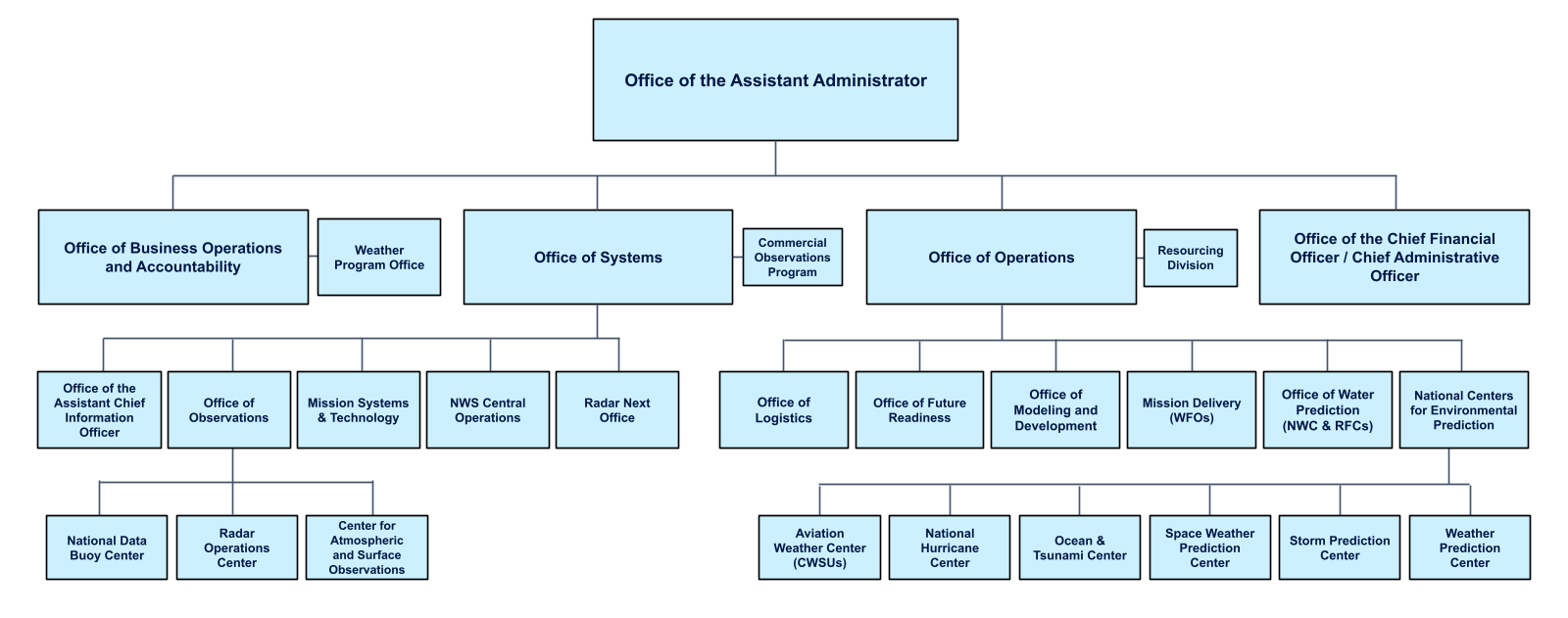

NWS Organizational Structure

An organizational chart outlining the NWS Reorganization. At the center is the Office of Assistant Administrator (outlined in red, denoting OAA / NWS Director). Branching out are four key pillars (outlined in orange): Office of Systems, Office of Business Operations and Accountability, Office of Operations, and Office of CFO/CAO.

Sub-offices branch off from these pillars:

Systems (Left): Connects to Office of Observations (linked to ROC, NDBC, CASO), Office of Assistant Chief Information Officer, Radar Next Office, Mission Systems and Technology, NWS Central Operations, and Commercial Observations Program.

Business Operations and Accountability (Top Center): Connects to Accountability & Planning, Facilities, and Human Capital Management.

Operations (Right): Connects to Monitoring Response & Coordination Center, Resourcing, National Centers for Environmental Prediction, Office of Water Prediction, Mission Delivery (Office), Office of Modeling and Development, Office of Logistics, and Office of Future Readiness.

CFO/CAO (Bottom Center): Connects to Budget Formulation, Budget Execution, Administrative Management, and Workforce Management.