Do you have an interest in observing and recording rain and snow in Michigan? If so, we are always looking for additional weather observers to join the Community Collaborative Rain, Hail, and Snow Network (CoCoRaHS). Reports from CoCoRaHS observers are used by many organizations at the local, state, and national level, including the National Weather Service. Precipitation can be highly variable over short distances — by volunteering as an observer, you play an important role in documenting how the weather affects your local community. This web page has information about the CoCoRaHS network and how to join, training materials for observers, live reports across the state, and recruitment materials. CoCoRaHS in Michigan is a joint effort by the Michigan State Climate Office, the National Weather Service, and the Colorado Climate Center at Colorado State University. |
CoCoRaHS Station MI-WS-3 Sign up here:
|
CoCoRaHS is an acronym for the Community Collaborative Rain, Hail, and Snow Network. CoCoRaHS is a unique, non-profit, community-based network of volunteers of all ages and backgrounds working together to measure and map precipitation. By using low-cost measurement tools, stressing training and education, and utilizing an interactive website and app, the aim is to provide the highest quality data for natural resource, education, and research applications. During the summer of 2025, over 400 observers were active across Michigan. There are over 25,000 observers across the United States, Bahamas, and Canada.
This is a community project. Anyone of any age can participate. The only requirements are an enthusiasm for watching and reporting weather conditions and a desire to learn more about how weather can affect and impact our lives.
All you need to participate is a standardized 4-inch manual rain gauge mounted in a good location outdoors to capture rain and snow, and internet access to relay reports via the CoCoRaHS app or website. Click here to learn more about approved rain gauges you can purchase through CoCoRaHS. Additional equipment to measure snowfall such as a snow board and ruler are optional but encouraged.
Digital/electronic rain gauges are not approved for CoCoRaHS use. This includes Davis, Ambient, La Crosse, AcuRite, and many others. Click here to see a more detailed discussion of why digital gauges are not acceptable.
Volunteers report rain and snow observations once per day in the morning (even if there was no accumulation). The time commitment is a few minutes a day. Typical observations are rain accumulation and snow accumulation, but observers can also measure the liquid equivalent in snow cover, report hail size, and send intermediate significant weather reports during heavy rainfall or snowfall events.
No. While we recommend submitting a precipitation report every day (even if it's zero) so that you can build a long and reliable record, as a volunteer, it's really up to you when and how often you want to report. You can report daily, during the rain or snow season, or whenever you are available to take measurements. We are simply grateful for any reports you can share.
CoCoRaHS is used by a wide variety of organizations and individuals. The National Weather Service, other meteorologists, hydrologists, emergency managers, city utilities (water supply, water conservation, storm water), insurance adjusters, USDA, engineers, mosquito control, ranchers and farmers, outdoor & recreation interests, teachers, students, and neighbors in the community are just some examples of those who use CoCoRaHS data.
The National Weather Service uses CoCoRaHS precipitation data daily in river forecast models, flood and drought forecasts, and forecast & warning verification. These reports are invaluable in determining the impact of storms on local communities. Your reports will truly make a difference! We also include the data in storm event and climate summaries for Southeast Michigan. Click here to view these summaries.
One of the neat things about participating in this network is coming away with the feeling that you have made an important contribution that helps others. By providing your daily observation, you help to fill in a piece of the weather puzzle that affects many across Michigan in one way or another. You can use your own data to track long-term precipitation patterns in your own backyard.
Click here for an application to join CoCoRaHS.
Daily Precipitation
This is the most common report used. Use this report to submit how much liquid and/or snow you received over the past 24 hours — even if it's just 0.00" (that is still a measurement!).
Multi-Day Accumulation
Use this report to submit how much liquid and/or snow you received over multiple days. This report is used for catching up if you have been away or unable to report for multiple days.
Significant Weather (SigWx) Report
Use this to report any heavy rain or heavy snow that you feel is significant and should be reported. You can even report any flooding that may be ongoing. This report is sent to your local NWS office in real-time.
Hail
This allows you to report any hail that is falling at your location. This report is sent to your local NWS office in real-time.
Condition Monitoring
This allows you to share information about the local effects of precipitation. Is your location wetter or drier than normal? This report is utilized in drought monitoring.
Ice Accretion*
This allows you to submit any ice measurements during freezing rain events.
Frost*
This allows you to report any occurrences of frost at your location.
Optics*
Do you see a halo, a sundog, a corona, or a rainbow? You can report it!
Snowflake*
This allows you to report the shape/character of snowflakes.
Thunder*
How many claps of thunder did you count? You can report that, too!
* These reports are unavailable in the CoCoRaHS app, but you can find them on the CoCoRaHS website once you log in.
No — as a volunteer, it's up to you which reports you want to fill out. Most CoCoRaHS observers just submit their daily precipitation report, but the other reports can certainly be valuable.
In the CoCoRaHS app, click "Add Obs" at the top, then use the drop-down menu at the top to switch between the different types of reports.
On the CoCoRaHS website, you can choose your report type from the menu on the left-hand side of the page under "Enter My New Reports".
Your daily precipitation report includes everything that has fallen over the previous 24 hours. For example, let's say it rains on April 10th. When you go out to measure what is in your rain gauge the next morning, you should be reporting what you measure on your April 11th daily precipitation report since it will account for everything over the previous 24 hours.
If for whatever reason you are unable to check your rain gauge on a daily basis, utilize the multi-day accumulation report when you return. All you have to do is adjust the start and end dates of your report to the days when you did not check your gauge and then enter the total amount of rain and/or snow that fell over the course of those days.
Snow is typically one of the more challenging aspects for CoCoRaHS observers. The most important thing to remember is that your snow depth does not go in your gauge catch field on your daily report.
There are five fields that are available to you when reporting snow:
Gauge Catch:
This is the liquid equivalent of your snow. Melt the frozen precipitation in the gauge and report it here. If you cannot melt or do not have a measurement, report NA here. Do not leave as zero, and do not enter your snowfall here.
Snowfall:
This is the depth of snow and/or sleet that fell in the past 24 hours measured on your snow board or other flat surface.
Snowfall SWE:
This is the water measured from a core of snow taken from your snow board. If you do not take a separate core, leave this as NA. Do not copy your precipitation into this field.
Snowpack Depth:
This is the total depth of snow and ice on the ground each day, whether or not any snow fell over the past 24 hours.
Snowpack SWE:
This is the water measured from a core of snow taken from the ground.
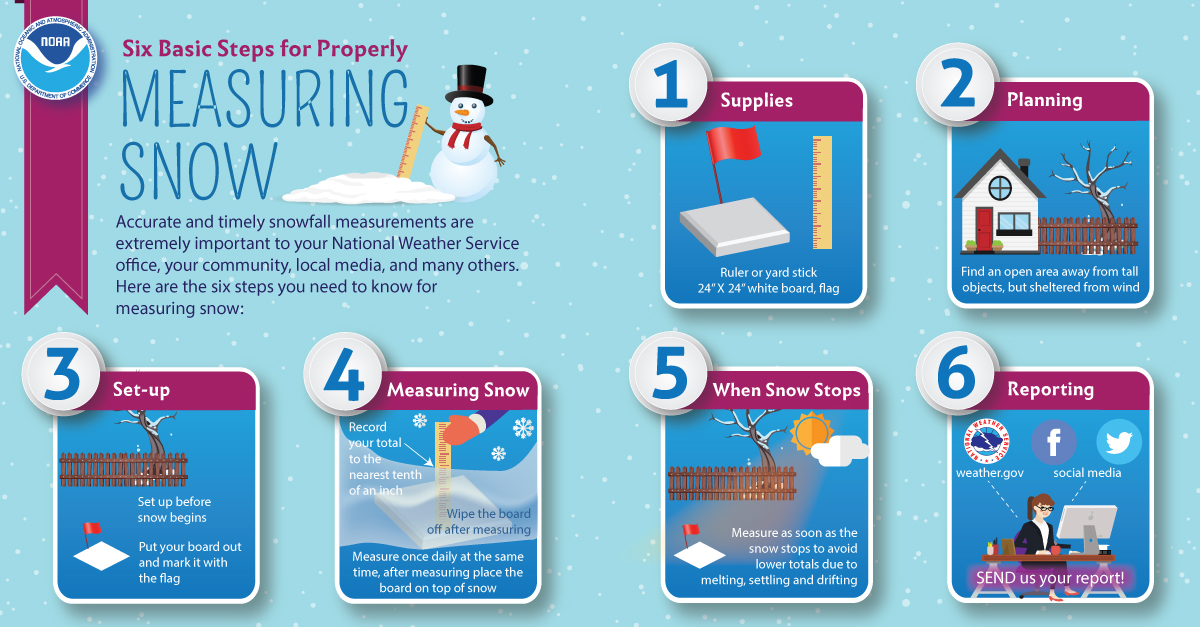
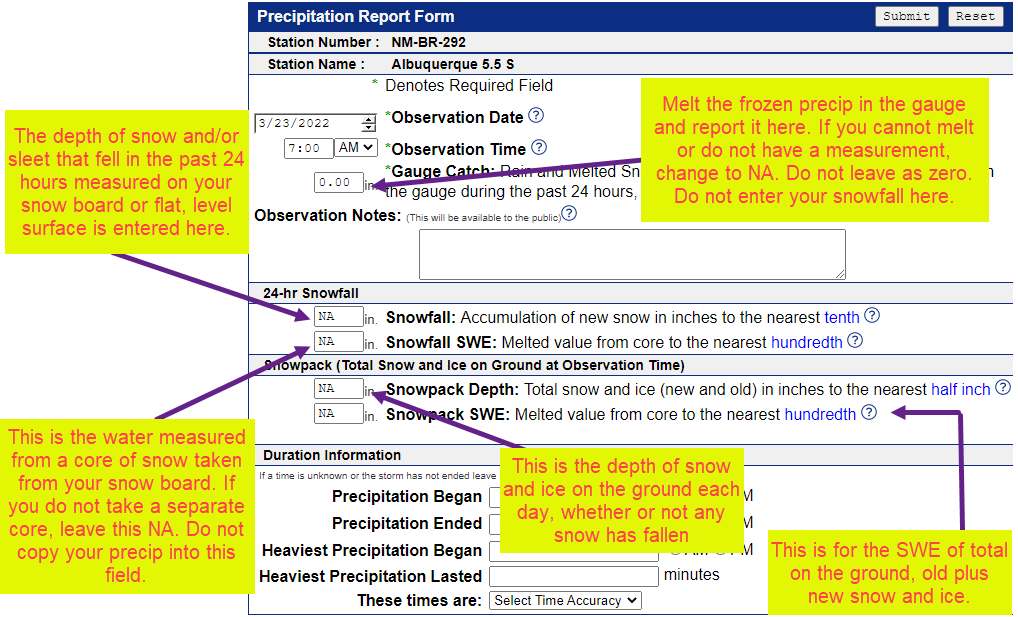
Click images to open full size in a new tab.
No — frost and dew are not precipitation that falls from the sky. These should not be reported on your daily precipitation report. If you would like to report frost, then make sure to do so utilizing the Frost report in your account.
You can include anything here that you feel is important for anyone who may use your report. Did you have trouble getting an accurate snow measurement because of wind and drifting? Did you record what time rain started and ended? Is there dense fog at your location? Maybe you have a thermometer set up, and you want to report what temperatures you measured. Put it all in the comments!
At the top of your CoCoRaHS app main screen, click the "List/Edit Obs" link at the top. Navigate to the report you need to edit, then click on the pencil icon in the "Actions" column. Make your edits and click "Update Observation" at the top.
CoCoRaHS has a wealth of training and other resources available on their website. Here are links to specific resources:
Training Slideshows
Training Animations
WxTalk Webinar Series
Things to know about rain, hail, and snow.
The interactive CoCoRaHS Mapping System is available on cocorahs.org. Static maps of today's reports for all of Michigan are available below.
Daily Precipitation |
Daily Snowfall |
Snowpack Depth |
 |
 |
 |
Any questions can be sent to your Michigan CoCoRaHS coordinator(s) listed here.





 Follow us on X
 Follow us on Facebook
 Follow us on YouTube
 DTX RSS Feed