
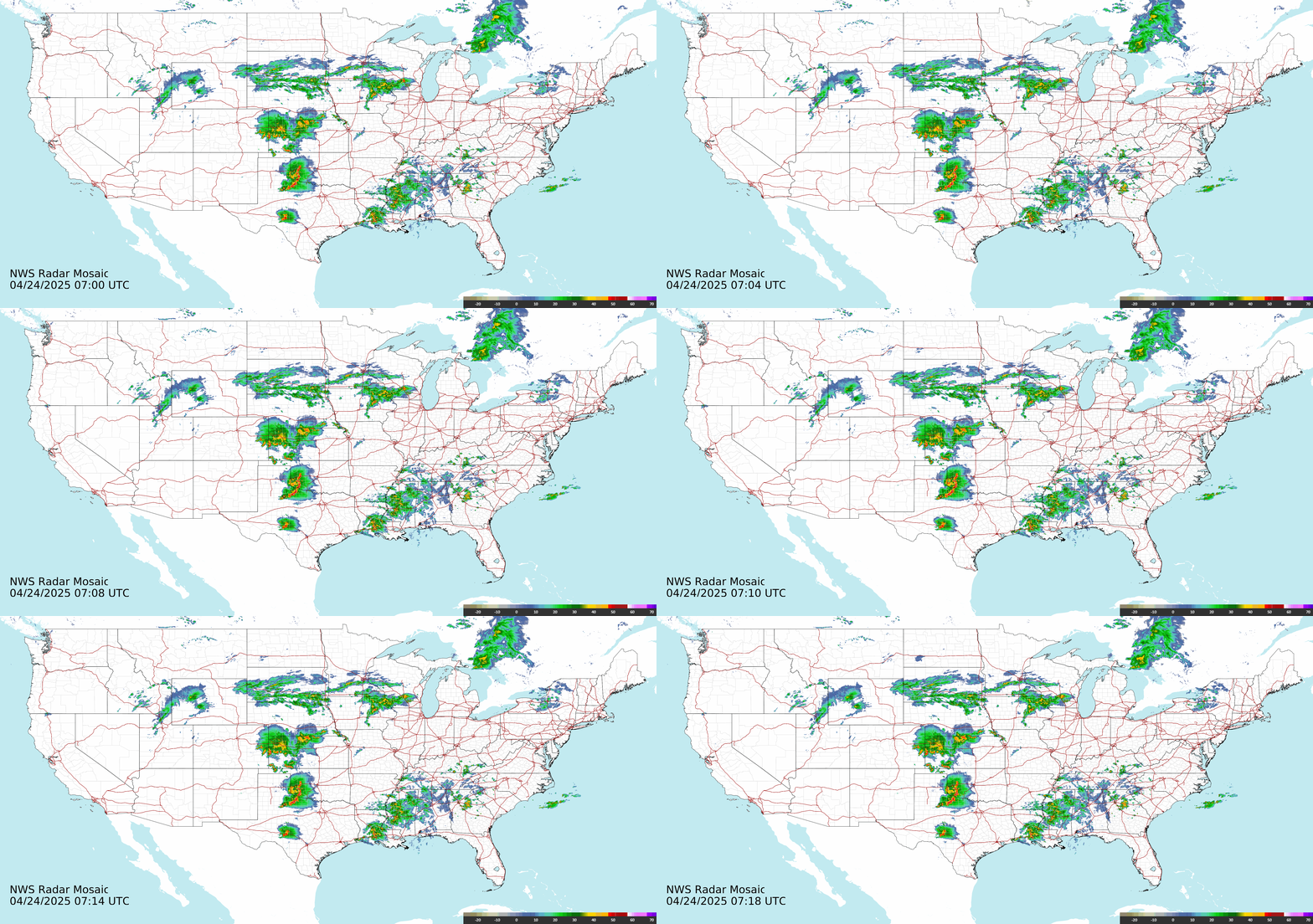
Heavy rain and widely scattered severe storms are expected over portions of the central and southern Plains into the Ohio Valley. Unseasonable warmth will continue for a few more days across the Midwest, Southeast, and Mid-Atlantic where several daily record highs could fall. Read More >
| ZOA CWSU Discussion | KSFO TAF TDA | |
| AWAITING CWSU INPUT | TAF TDA KSFO/KSQL METAR METARArea PIREPs PIREP |
|
| Satellite | Webcams, Ceiling≤030 Prob | |
|
Webcams
|
||
| SIERRA 03 Hour Forecast | SIERRA 12 Hour Forecast | SIGMETs |
| TANGO 03 Hour Forecast | TANGO 12 Hour Forecast | |
| ZULU 03 Hour Forecast | ZULU 12 Hour Forecast | |
| Area Forecast Discussion | Forecast Maps |
|
922 FXUS66 KMTR 141202 AFDMTR Area Forecast Discussion National Weather Service San Francisco CA 502 AM PDT Wed Oct 14 2026 ...New AVIATION, FIRE WEATHER... .KEY MESSAGES... Updated at 1216 AM PDT Wed Oct 14 2026 - Warming trend continues through the end of the work week with above normal temperatures peaking Friday - Coastal Flooding Advisory remains in effect through 4 PM today for bayshore locations along the San Pablo Bay - Elevated fire weather conditions due to moderate offshore flow and very dry conditions across the higher elevations mid to late week && .SHORT TERM... Issued at 1216 AM PDT Wed Oct 14 2026 (Today and tonight) Upper level troughing continues to progress eastward with ridging building just to our west over the Pacific Ocean. The warming trend becomes more noticeable on Wednesday as ridging starts to push inland and becomes the dominate force across our region. High temperatures will be more seasonable in the upper 70s to low 80s across the interior and 60s along the coastline. Morning low temperatures will remain slightly chillier in the 40s to 50s Wednesday morning and Thursday morning. Temperatures continue to warm on Thursday with highs reaching into the 80s to low 90s across the interior (5-10 degrees above normal) and 60s to 70s along the coast. Little to no cloud cover is expected overnight with upper level ridging keeping the marine layer mixed out. This in turn is creating much drier daytime and overnight conditions, particularly across the higher elevations. Our main concern for the upcoming week continues to be the potential for multiple rounds of offshore winds in the overnight through late morning hours with emphasis on the North Bay Interior Mountains. In the short term, offshore winds are expected Tuesday night into Wednesday but they are expected to be weaker than what is expected Thursday into Friday. The SFO-WMC pressure gradient shows it peaking around -3 to -4 mb overnight tonight into Wednesday. This is a fairly weak gradient with offshore winds not anticipated to be too strong tonight and gusts peak around 20 mph for the North Bay Interior Mountains tonight. The story is a little different heading into Wednesday. The SFO-WMC gradient initially starts out fairly weak (-3 to -4 mb) but it looks to strengthen to -8 to -9 mb by late Thursday morning. This indicates more moderate offshore winds are likely across the North Bay Interior Mountains with gusts between 30 to 35 mph likely. Why the changeup? To explain, we go back to our synoptic setup. As the trough exits to our east, a part of it splits off from the jet stream and becomes a cut-off low that gradually retrogrades back towards the Desert Southwest Wednesday night into Thursday morning. As the cut-off low settles over Southern California, it will force the upper level ridging over Northern California to take on a more positive tilt (northeast to southwest orientation) which is more conducive for offshore flow across the region. The combination of strengthening offshore winds Thursday and dry daytime/overnight conditions will result in elevated fire weather concerns for the higher elevations with emphasis on the North Bay Interior Mountains. Elevated fire weather concerns will continue through Friday with further discussion in the Long Term. && .LONG TERM... Issued at 1216 AM PDT Wed Oct 14 2026 (Thursday through Tuesday) Moderate offshore flow continues across the higher elevations Thursday afternoon through Friday morning with the SFO-WMC gradient peaking around -10 to -11 mb Thursday night into Friday morning. The NAM suggests further strengthening to -12 to -13 mb is possible which could support stronger gusts than outlined in the short term (currently forecast peak gusts of 30 to 40 mph). The driest conditions are expected overnight Thursday into Friday with overnight RH recoveries only reaching 25-35% across the highest elevations and daytime RH values dropping back into the 10s to 20s. Winds gradually diminish late morning into the afternoon as the pressure gradient relaxes. Elevated fire weather conditions continue for the higher elevations through Friday with conditions improving as winds decrease. If you are participating in any activity involving fire be very cautious and make sure sparks/flames do not escape as fuels are incredibly dry and ready to go. High temperatures peak Friday in the 80s to low 90s with patches of upper 90s across the higher elevations and southern Santa Clara Valley. Temperatures cool slightly into the 80s by Saturday with only a few hot spots reaching the low 90s as the ridge relaxes and troughing becomes more dominant. The cut-off low will then merge with the jet stream and result in widespread troughing across the West Coast late weekend into early next week. As this trough pushes inland it will bring us our first weak storm system of the season. Initial guidance shows a weak cold front passing through California early next week that will bring both a return of below normal temperatures in the 60s to low 70s, a chance for light rain, and gusty onshore winds. Fall mornings return as well with morning lows dropping back into the 40s again late weekend into early next week. Initial guidance suggests a more widespread potential for light rain (up to a few tenths of an inch) early to mid next week. Onshore winds ramp up along the coast and across mountain gaps/passes Sunday into mid next week. The current forecast does not currently meet Wind Advisory criteria but it is something to keep an eye on as this system approaches given the stronger winds already associated with it. && .AVIATION... (12Z TAFS) Issued at 502 AM PDT Wed Oct 14 2026 High pressure will lead to VFR conditions over the Bay Area and Central Coast. A few hi-res models try to show some ribbons of stratus trying to form late tonight and into the morning near the North Bay coastline and the San Francisco peninsula. Given high pressure and offshore winds developing, confidence is low on develop and timing. Opted to hint at this possibility, but ultimately kept most sites at VFR. Medium to high confidence in the forecast. Vicinity of SFO...Onshore flow is expected this morning, though we may see a few hours of light and variable winds shortly after sunrise. After that, onshore winds around 10-15kt return for the afternoon and then decrease after sunset. Offshore winds are expected Thursday morning. VFR conditions are expected during the TAF cycle. SFO Bridge Approach...Similar to SFO. Monterey Bay Terminals...Offshore winds are expected for through the morning with onshore winds by late morning or early afternoon. Onshore flow should continue through the evening, before another round of offshore winds returns late evening and into early Thursday morning. VFR conditions will prevail. && .MARINE... (Today through Monday) Issued at 259 AM PDT Wed Oct 14 2026 Seas will continue to subside today with moderate seas expected for the offshore zones through the week while nearshore waters observe moderate to slight seas. During this time frame gentle to fresh northerly breezes persist. Moderate to fresh northerly winds return for the weekend, which should lead to rough seas. && .FIRE WEATHER... Issued at 502 AM PDT Wed Oct 14 2026 Elevated to near critical fire weather conditions are expected for the higher elevations late tonight through Friday morning. The main areas of concern will be for the North Bay Interior Mountains and East Bay Hills. The strongest winds look to be over the North Bay Interior Mountains where gusts 30-40 mph are possible, perhaps up to 45mph or higher for the highest elevations. The East Bay Hills will be breezy as well, but may be closer to 25-35 mph with locally higher gust for exposed ridges and areas of higher terrain. Both areas will be dry with poor overnight RH recovery, which combined with the breezy winds, warmer weather, and available fuels leads to the elevated to near critical fire weather conditions. && .MTR WATCHES/WARNINGS/ADVISORIES... CA...Coastal Flood Advisory until 4 PM PDT this afternoon for CAZ506. PZ...None. && $$ SHORT TERM...Kennedy LONG TERM....Kennedy AVIATION...KR MARINE...KR Visit us at www.weather.gov/sanfrancisco Follow us on Facebook, X, and YouTube at: www.facebook.com/nwsbayarea x.com/nwsbayarea www.youtube.com/nwsbayarea |
|
| Yesterday | ⇛Visible ⇛Nighttime ⇛GeoColor+GLM | Today | |
| 24-Hour Temp Change | 24-Hour RH Change | ||
⇛Visible ⇛Nighttime ⇛GeoColor+GLM
 |
|
Additional Links
National Airspace System Status
Other Webcams:
Alert California San Bruno Mountain
Alert California Sutro Tower 2
Alert California Coll of San Mateo Bldg36



 Follow us on X
 ZOA RSS Feed