The National Weather Service office in Billings, Montana is part of a nationwide network of offices under the National Weather Service (NWS). The National Weather Service is a division of the National Oceanic and Atmospheric Administration (NOAA), an agency of the U.S. Department of Commerce.
We are located in the west end of Billings. Our office staff consists of 23 people. The mission of the National Weather Service is to protect life and property by issuing warnings and forecasts for tornadoes, floods, hurricanes, winter and summer storms, and all manner of severe or extreme weather.
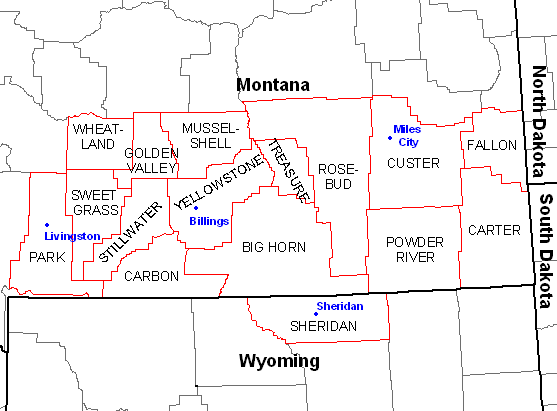
The National Weather Service in Billings supports this mission by issuing severe weather warnings, advisories, and short-term forecasts for 15 counties in south-central and southeast Montana, as well as Sheridan County in Wyoming.
The National Weather Service in Billings issues daily forecasts and issues severe weather warnings, advisories, and short-term forecasts for 15 counties in south-central and southeast Montana, as well as Sheridan County in Wyoming. This area covers just over 41,000 square miles with a total population of around 250,000 people. Below is a map of our area of responsibility.
January 1, 1883: First written record of weather observations at Billings two years before city was incorporated. Observations taken by U.S. Army for six months.
April 18, 1894: Considered date of continuous observations. U.S. Weather Bureau was only 4 years old at this time. Station moved around to many locations until 1934.
1894-1898: Dr. E.P. Townsend was 1st weather observer. Observation equipment located on roof of the Savarsey Building located on Montana Avenue between North 28th and North 29th Streets. Tallest building (3 levels) in town at the time. Weather signal flags displayed on top of building.
1899-1902: I. D. O. Donnell and W.E. Baker became observers. Equipment moved to Maverick Hose Company (presently Northern Pacific Railroad) at Minnesota and 27th Street.
1902-1908: Martin Gates, Gust Eastman and J.C. Bond, volunteer firemen, took observations.
1908: Station moved to City Hall on 1st Ave and 28th Street and C.E. Steel, YMCA Secretary, became observer.
1909: Station moved yet again to 403 Yellowstone Avenue where C.S. Bell began taking observations.
1912-1920: D.J. Cole, owner of D.J. Cole Company at 2817 Montana Avenue, took over observations.
1921-1934: H.W. Peterson took observations at his residence at 505 Lewis Avenue.
1934: Billings Weather Bureau Office officially established at airport. Early area of responsibility included South Central and Southeastern Montana as well as Northwestern Wyoming, an area that was larger than New York and Pennsylvania. Responsibilities of the office eventually included daily forecasts, hourly aviation weather reports, fire weather forecasts, Yellowstone River basin forecasts, balloon observations, hourly and daily weather conditions, and aircraft observations, which cost $19.18 for each flight in 1934.
July 1, 1934: Billings Airport became official station for Billings.
1934 to 1951: Arthur F. Salsbury recorded observations at his residence at 536 Lewis Avenue.
1951: Station was moved to city water plant and remains there today.
1979: The Automation of Field Operations and Services (AFOS) system arrives at office, replacing teletype dissemination method. AFOS was a mainly text based system but graphics were also introduced.
1980s: First weather radar became operational.
1995: Office moves to it's current location at 2170 Overland Avenue. Current doppler radar also established. High tech, modern services also started to take shape including graphical forecast based systems, 7 day forecasts and extended outlooks, fire weather and aviation forecasting, and hydrologic and climate services.
2000: Current system, Advanced Weather Information Processing System (AWIPS), arrives. AWIPS is a technologically advanced information processing, display, and telecommunications system.
Meteorologist In Charge (MIC): The MIC is in charge of the Weather Service Forecast Office (WFO). The MIC's job includes administrative duties, personnel management, and operational oversight of meteorological services. The MIC can also fill in as a forecaster, if needed.
Warning Coordination Meteorologist (WCM): The WCM is one of the most public positions in the forecast office. The WCM coordinates all warning functions of the office including spotter training and being a voice to the local media.
Science Operations Officer (SOO): The SOO serves as the office's principal and senior scientific advisor and is in charge of training for all employees. The SOO makes sure that all hydrometeorological products and services provided by our office meet local, regional, and national NWS standards.
Electronic Systems Analyst (ESA): The ESA is in charge of overseeing the maintenance of all equipment in the forecast office. This includes maintaining the local area network, AWIPS system administration, heating and cooling equipment, ASOS, upper air, and radar instruments.
Information Technology Officer (ITO):The ITO serves as a software and information technology expert with responsibility in three primary areas: application development/integration, information technology management, and systems analysis. The ITO provides overall guidance and coordination for the computer-related focal points. In addition, the ITO's function encompasses computer programming, software installation, documentation, and troubleshooting of computer code. The ITO localizes applications on mission critical systems such as AWIPS, LDAD, and CRS in conjunction with any focal points.
Observing Program Leader (OPL): The OPL ensures that a full range of technincal support and assistance is provided for WFO operations and other basic activities, especially the incorporation of timely, high quality observational data into WFO forecast and warning decision-making processes.
Administrative Support Assistant (ASA): The ASA performs a wide range of administrative functions for the management team; this can include performing technical aspects of all administrative programs and activities for the office related to budget, funds control, purchasing, procurement requests, contract monitoring, bankcard, property, vehicles, travel, training, personnel actions, time and attendance, mail, and maintaining office supplies and equipment.
Meteorological Intern and Hydrometeorological Technician (HMT): The Meteorological Intern and the HMT essentially serve the same position. The Hydrometeorological Technician serves as a senior technician for a Weather Service office performing the following duties: provides weather advice and guidance; analyzes and evaluates local synoptic scale and mesoscale weather and hydrological data; collects, analyzes, interprets and provides recommendations on the data quality; establishes relationships with and communicates with a variety of officials and sources of information; assists on radar surveillance using the NEXRAD system, activating and using appropriate diagnostic procedures to ensure data is disseminated to all authorized users; and issues scheduled and unscheduled weather forecast products.
Electronics Technician (ET): Electronics/Engineering services are vital to the National Weather Service's increasing equipment-oriented activities. Approximately 9,000 individual electronics equipment and systems are presently used in support of the NWS field operations. Maintenance of essential equipment is performed by over 400 field based technicians at over 300 stations throughout the United States including its territories.
Meteorologists: National Weather Service meteorologists are invloved in aviation forecasting, fire weather forecasting, general forecasting, radar meteorology. Other activities include studies of local forecasting problems, public preparedness, and informational programs. Most forecast offices operate 24 hours a day on rotating shifts.



 Follow us on X
 Follow us on Facebook
 Follow us on YouTube
 BYZ RSS Feed