National Weather Service United States Department of Commerce

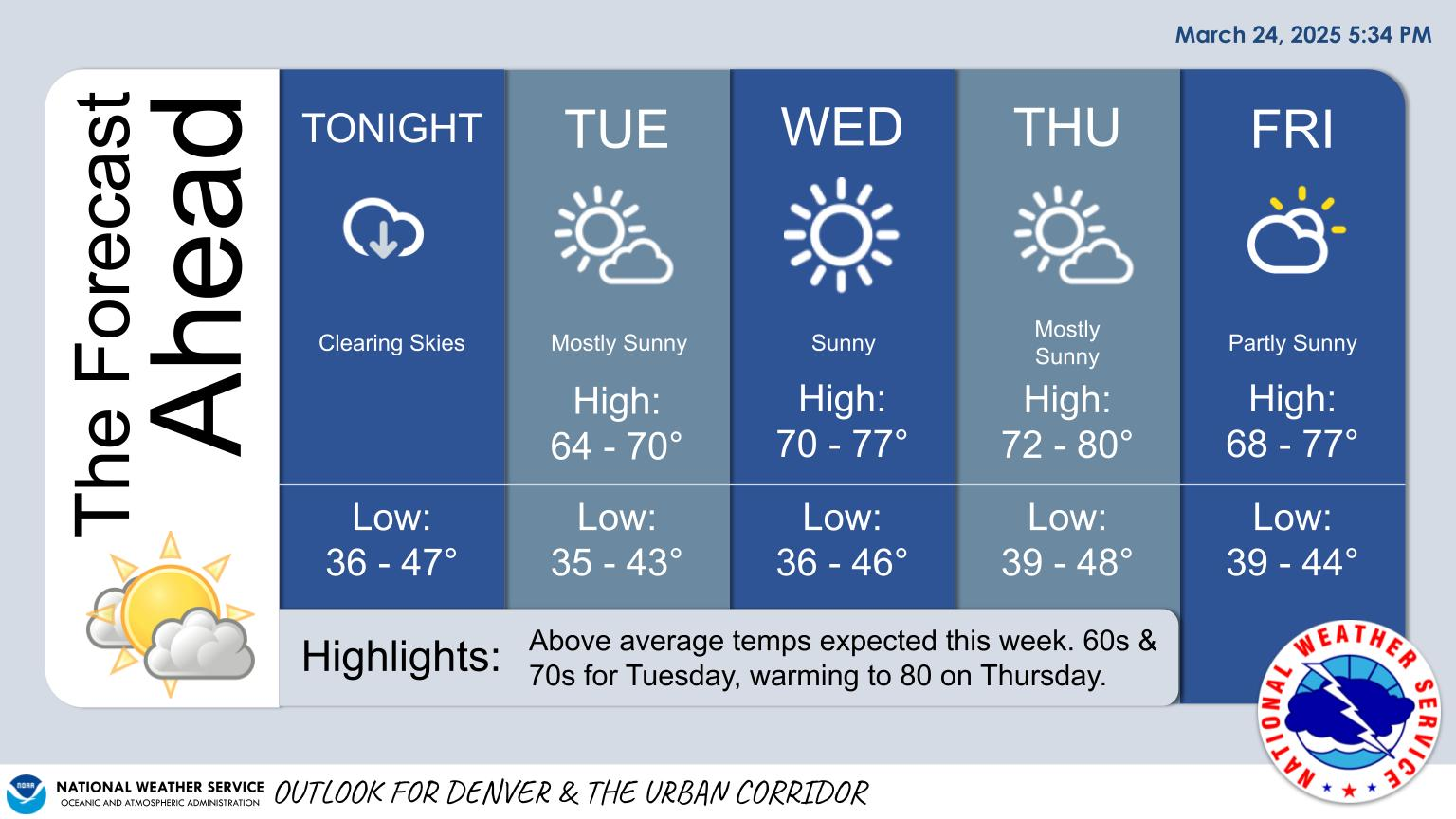
Snow showers will move into the mountains tonight, and become more widespread on Tuesday. A few inches of snow can be expected over the northern tier of mountains by the time it winds down Tuesday evening, with lighter amounts along the I-70 Corridor. Roads may be slick at times, mainly over and near the higher mountain passes. On the plains, rain showers will develop near the Wyoming border by early Tuesday morning and spread southward across the rest of the plains and I-25 Corridor late Tuesday morning through the afternoon. Temperatures will be cooler and even a few degrees below normal for a change.
Meteorological winter, defined as December - February, really wasn't much of a "winter" for Denver. We tied for the 2nd warmest ever on record, just a half degree shy of the record warm winter of 1933-1934. We did break the record for number of 60+ degree days, reaching that mark a whopping 41 times over the course of the three months, shattering the previous mark of 34 times set in the dry and warm winter of 1980-1981. We even reached 70 degrees seven times, tying with the winter of 1939-1940. Precipitation was rather scarce, with a meager total of 0.67" of precipitation and only 13.2" of snowfall, placing us in 15th and 20th place respectively since records begain in the late 1800s.
It was one of the warmest and driest Februaries for much of northeast Colorado. Denver saw it's least snowiest February ever with just a trace of snowfall (tied with February, 2009). Precipitation totaled a meager 0.02", which puts us at second driest ever - tied with 2005 and only behind the 0.01" that fell in February, 1970. Meanwhile, temperatures were also extremely warm, averaging the third warmest February on record at 42.1°F. There was only one day where the high temperature did not exceed the freezing mark, and seven days where the lows didn't even reach 32°F. Records began in 1872 for temperatures and precipitation, and 1882 for snowfall.