The 19th Annual Climate Prediction Applications Science Workshop (CPASW) will bring together a diverse community to share developments in research and application of weather and climate information for societal decision-making. Participants will include researchers, service producers, resource managers, planners, practitioners, social scientists, and others making weather and climate-sensitive decisions. NOAA’s National Weather Service Climate Services Branch, Michigan State University, the Michigan State Climate Office, and many climate services partners are collaborating in the organization of the 2022 CPASW.
The workshop will convene in East Lansing, Michigan, May 24-26, 2022, for discussion centered on the theme of “Toward equitable and actionable climate services across communities and timescales”.
The workshop will address the following focus areas:
Equitable and Seamless Climate Services
Effective communication of subseasonal-to-seasonal (S2S) products and services that maximizes utility among diverse and underserved stakeholders
Co-production of S2S climate services and climate change information between users and producers
Transboundary issues and partnerships (e.g., cross-border services, sustaining international partnerships, effective stakeholder engagement including tribes and underserved communities, etc)
Climate Impact-based Decision Support Tools and Service Delivery Across Sectors
Agriculture, Forestry, & Fisheries
Water Resources
Energy, Transportation, & Urban planning
Emergency Management
Coastal Services
Heat and health
User Engagement and Service Requirements
Social, behavioral, and economic science integration
Balancing collaborative partnerships across climate communities in identifying user needs and extending service capabilities
The workshop will gather experts from the region, the nation, and the world to focus on extreme events and the role of climate services. It will provide an opportunity for sharing effective strategies for understanding decision maker requirements, communicating extremes threats, and the heightened uncertainty and attribution of extreme events.
Who should attend?
Agriculture and ranching communities
Water, fisheries, and natural resource managers
Health community
Forestry, wildlife, and landscape conservation specialists
Emergency management personnel
Infrastructure, energy, transportation, and urban planners
Non-governmental Organizations with focus on community and environmental health and safety
Applied climatologists and researchers who use climate information
Decision-makers who utilize climate predictions, products, and services
Developers and providers of climate data, forecasts, applications, and tools
Climate extension specialists and communicators of climate information
Social scientists who work with climate information users and stakeholders
Tribal leaders and environmental & emergency preparedness coordinators
International organizations
Abstract Submission Period Ended
The 19th Annual Climate Prediction Applications Science Workshop (CPASW) will bring together a diverse community to share developments in research and application of weather and climate information for societal decision-making. Participants will include researchers, service producers, resource managers, planners, practitioners, social scientists, and others making weather and climate-sensitive decisions. NOAA’s National Weather Service Climate Services Branch, Michigan State University, the Michigan State Climate Office, and many climate services partners are collaborating in the organization of the 2022 CPASW.
The workshop will convene in East Lansing, Michigan, May 24-26, 2022, for discussion centered on the theme of “Toward equitable and actionable climate services across communities and timescales”.
The Workshop will address the following Focus Areas:
Equitable and Seamless Climate Services
Effective communication of subseasonal-to-seasonal (S2S) products and services that maximizes utility among diverse and underserved stakeholders
Co-production of S2S climate services and climate change information between users and producers
Transboundary issues and partnerships (e.g., cross-border services, sustaining international partnerships, effective stakeholder engagement including tribes and underserved communities, etc)
Climate Impact-based Decision Support Tools and Service Delivery Across Sectors
Agriculture, Forestry, & Fisheries
Water Resources
Energy, Transportation, & Urban planning
Emergency Management
Coastal Services
Heat and health
User Engagement and Service Requirements
Social, behavioral, and economic science integration
Balancing collaborative partnerships across climate communities in identifying user needs and extending service capabilities
Weather, water, and climate extremes are a unifying issue across all of these focus areas contributing to significant impacts on the economy and society. Applications of climate information at various timescales, including sub-seasonal to seasonal and beyond, help inform preparedness activities for disruptive events and long-term changes, supporting resilient communities and their economies. Defining and clarifying provision of equitable climate services across communities and timescales can play a critical role in targeted and successful decision support. We invite abstracts for workshop presentations that address the use of and/or opportunities for climate data and products including monitoring, predictions, and projections in any of the focus areas listed above. We also encourage abstracts highlighting best practices in the areas of communication and outreach, integration of social and economic sciences, decision support tools, and preparedness methods to advance adaptation and mitigation efforts. The workshop will also include special discussions related to sector-specific applications, water and environmental issues, and international aspects.
Opening RemarksJeff Andresen, Michigan State University | Michigan State Climate OfficeMarina Timofeyeva, NOAA NWS Climate Services BranchWelcome AddressJohn Murphy, Chief Operating Officer, NOAA National Weather Service
9:00 - 9:30
Keynote Address
Just Transition to a Carbon Neutral Economy: A Welcome to Michigan and Inside Look at the MI Healthy Climate PlanJames Clift, Deputy Director, Michigan Department of Environment, Great Lakes, and Energy
9:30 - 9:45
Break (15 Minutes)
9:45 - 10:45
Session 1 Part 1: Expanding Climate Services to Better Serve Users Moderator: Jeff Andresen, Michigan State University
Going To Extremes In Weather And Climate Services: Some Lessons From The US Midwest And ElsewhereDoug Kluck, NOAA / NCEIHow National Weather Service Central Region Offices are Working toward Providing More Actionable Climate Information to Core Partners through Consistent Subseasonal to Seasonal Impact-Based Decision Support ServicesAudra Bruschi, NWS Central Region HeadquartersArctic Environment Threats to Military Facilities, Operations, and PlanningJason Senter, U.S. Air Force
10:45 - 11:00
Break (15 Minutes)
11:00 AM - 12:20 PM
Session 1 Part 2: Expanding Climate Services to Better Serve Users Moderator: Marina Timofeyeva, NWS Climate Services Branch
Decision Support Messaging of Rare Weather/Climate Events: A Retrospective of the December 15-16, 2021 Record Warmth & Severe Weather in the MidwestJeff Boyne, NWS LaCrosseClimate Change IDSS for WFO Local PartnersRay Wolf, NWS DavenportAnnual Climate Trends and Impacts Summary for the Great Lakes Basin: Communicating Climate Information to a Binational AudienceJeff Andresen, Michigan State UniversityVIRTUAL: Climate Change Data For Minnesota: High-Resolution Climate Information and Dedicated Extension Programming to Accelerate Cross-Sector Resilience EffortsBrenda Hoppe, University of Minnesota
12:20 - 1:40
Lunch (on your own)
1:40 - 3:00
Workshop Breakout Sessions
Breakout Group 1: Climate Impact-based Decision Support Tools and Service Delivery Across Sectors (Room 110)Moderator: Beth Hall, Purdue UniversityScribe: Audra Bruschi, NWS Central Region HeadquartersBreakout Group 2: Partnership Engagement (Willy Room)Moderator: Doug Kluck, NOAA NCEIScribe: Jenna Meyers, NWS Climate Services BranchBreakout Group 3: Equitable and Seamless Climate Services (Lincoln Room)Moderator: Marina Timofeyeva, NWS Climate Services BranchScribe: Jeff Boyne, NWS LaCrosse
3:00 - 3:30
Break (30 Minutes)
3:30 - 4:30 PM
Report Outs and Wrap Up Moderators from each breakout group
Tuesday Morning Welcome Speaker: John Murphy, NOAA National Weather Service
John D. Murphy is the Chief Operating Officer (COO) of NOAA’s National Weather Service (NWS). He has overall responsibility for day-to-day mission execution units responsible for delivering NWS weather, water, climate, and space weather products, services, and information as well as the budgetary planning for 11 National Service Programs. He joined NWS in 2011 after serving more than 29 years with the United States Air Force as a career meteorologist and finally as Commander of the Air Force Weather Agency and Deputy Foreign Policy Advisor to United States Strategic Command.
Tuesday Morning Keynote Speaker: Liesl Eichler Clark, Michigan Department of Environment, Great Lakes, and Energy (EGLE)
James Clift is Deputy Director of the Michigan Department of Environment, Great Lakes, and Energy (EGLE), where he oversees the department’s policy and engagement work. He heads the offices of Legislative Affairs, Public Information, and Great Lakes; as well as three offices created under the administration of Gov. Gretchen Whitmer: Climate and Energy, Clean Water Public Advocate, and Environmental Justice Public Advocate.
James helped launch all three new offices – vital steps in pursuing the state’s goal of carbon neutrality in an equitable manner that provides opportunity for all Michiganders and protects the state’s world-class water resources.
He began his work in the state Capitol as a Michigan Senate environmental policy analyst. More recently, he was policy director at the Michigan Environmental Council for 20 years, working on environmental policy with the council’s more than 70 member and partner organizations. A fixture at the Capitol, he coordinated the council’s legislative and policy work on an array of environmental issues including water protection, environmental justice, clean energy, air quality, and climate mitigation and adaptation.
A graduate of Central Michigan University, James earned a Juris Doctorate degree from Wayne State University, where he spent two years assisting in research and editing textbooks and other works of Prof. Robert Abrams, a leading U.S. expert in water law. James is a member of the State Bar of Michigan and its Environmental Law Section.
Wednesday, May 25 2022
*****All Times in Eastern Time Zone*****
8:00 AM
Lincoln Room Open (Kellogg Conference Center)
8:30 - 9:00
Invited Talk
Midwestern Regional Climate Services for Agriculture: Working in Regional PartnershipsDennis Todey, Director, USDA Midwest Climate Hub
9:00 - 9:40
Session 2 Part 1: Preparing for Drought Moderator: Steve Baxter, NWS Climate Services Branch
Predictability of Drought using Different Types of Drought Indices in the Western United StatesMohammad Hadi Bazrkar, Texas A&MPredicting the Risk of a Developing Flash Drought EventBeth Hall, Purdue University
9:40 - 9:55
Break (15 Minutes)
9:55 - 10:55
Session 2 Part 2: Preparing for Drought Moderator: Steve Baxter, NWS Climate Services Branch
The Climate Toolbox's Subseasonal Forecast and Drought Stripes ToolsKatherine Hegewisch, University of California MercedRecommendations from the NWS Western States Drought WorkshopChelsea Peters, NWS Las VegasCPC's Experimental Water Year Outlook ToolEmerson LaJoie, NWS Climate Prediction Center
10:55 - 11:10
Break (15 Minutes)
11:10 AM - 12:10 PM
Session 3: Infusing Climate Information for Agricultural Decisions Moderator: Audra Bruschi, NWS Central Region Headquarters
Improving Cover Crop Management in Illinois with Subseasonal Climate PredictionTrent Ford, University of IllinoisChanges in Precipitation Indicators Across the Midwestern and Great Lakes Regions of the United States: Climatic Implications for Corn-soy Production from Field to RegionWilliam Baule, Michigan State UniversityHistorical and Future Variability in Growing Season Heat Stress and Fall Storage Conditions with Shifts in Planting Date: An Example for Potato Production in Michigan, USAJulie Winkler, Michigan State University
12:10 - 1:30
Lunch (on your own)
1:30 - 6:30
Field Trip & Dinner
Workshop attendees will enjoy a field trip to visit the beautiful Meijer Gardens and Sculpture Park in Grand Rapids, Michigan followed by a tour and dinner at the Schwallier’s Country Basket Apple Orchard.
Itinerary and details below:
1:30pm Bus leaves Kellogg Center
2:30pm Stop at Meijer Gardens, Grand Rapids, MI
Tour of Gardens
4:30pm Bus leaves Meijer Gardens
5:00pm Stop at Schwallier’s Country Basket Orchard, Sparta MI
Apple Orchard Tour and Talk by Phil Schwallier (Tree Fruit Grower & Extension Agent)
5:30pm Dinner @ Schwallier’s County Basket
6:30pm Bus leaves to return to Kellogg Center
Frederik Meijer Gardens & Sculpture Park opened in April 1995 after 13 years of planning and fundraising by the West Michigan Horticultural Society. In 1990, Fred & Lena Meijer were asked for their support, and they embraced the concept of a major cultural attraction centering around horticulture & sculpture. The original vision has turned into a top cultural destination in the Midwest region, known internationally for the quality of the art and gardens.
Meijer Gardens' commitment is to create a legacy of lifelong learning, enjoyment and a rich cultural experience for generations to come. It is a non-profit organization, privately funded by grants, foundations and individual and corporate gifts. The organization is operated by almost 200 full and part-time staff, more than 850 active volunteers and supported by gifts from more than 28,000 member households and many donors.
Meijer Gardens promotes the enjoyment, understanding and appreciation of gardens, sculpture, the natural environment and the arts.
www.meijergardens.org
Schwallier’s Country Basket has been a family-owned business since we first opened our barn doors in 1989. We are located in Sparta, Mich., in the heart of West Michigan’s apple capital known as “the Ridge”— just a short drive north of downtown Grand Rapids. They are dedicated to serving friends and family who come from near and far to enjoy our delicious treats, fresh produce, and simple, satisfying slice of farm life.
The one-of-a-kind store has grown from humble beginnings as a roadside produce stand into a thriving farm market, complete with giant corn maze, petting farm, pumpkin patch, cow train and wagon rides, and other attractions. And each year we strive to add new, fun activities for families at the farm.
www.schwalliers.com
Wednesday Invited Speaker: Dennis Todey, USDA Midwest Climate Hub
Dennis Todey is the Director of the Midwest Climate Hub in Ames. He is a native Iowan with his BS and PhD from Iowa State in Meteorology and Agricultural Meteorology. He has spent two stints in South Dakota, first completing his MS at the South Dakota School of Mines and Technology and most recently as Associate Professor and State Climatologist for South Dakota at South Dakota State University. He is well known regionally as a speaker and media source on various climate issues and is the former president of the American Association of State Climatologists.
Thursday, May 26 2022
*****All Times in Eastern Time Zone*****
8:00 AM
Lincoln Room Open (Kellogg Conference Center)
8:30 - 9:00
Invited Talk (Virtual)
CPC National and International Sub-Seasonal to Seasonal (S2S) Decision Support ServicesDavid DeWitt, Director, NWS Climate Prediction Center
9:00 - 10:00
Session 4: Addressing Services for Extreme Heat Moderators: Jeff Boyne, NWS LaCrosse
A Socio-spatial Model of Hospitalizations from Exposure and Sensitivity to High TemperaturesJuan Declet-Barreto, Union of Concerned ScientistsWeek 3-4 Forecasting of Extreme Heat: a new tool-based SST and regional soil moisture patternsEvan Oswald, NWS Climate Prediction CenterVIRTUAL: Understanding Local Variations in Wet Bulb Globe Temperature (WBGT) and Tailoring the WBGT Forecast Tool to Local EnvironmentsCharles Konrad, University of North Carolina at Chapel Hill
10:00 - 10:15
Break (15 Minutes)
10:15 - 11:15
Session 5 Part 1: Climate Decision Support Services Moderator: Steve Baxter, NWS Climate Services Branch
The Cellular Cooperative Observer Program ProjectPilar Trevino, NWS PaducahThe Use of Social Science and Expanding the IDSS footprint at the Climate Prediction CenterJon Gottschalck, NWS Climate Prediction CenterVIRTUAL: Updating the CPC T2M Observational Verification Dataset and Impact on the Seasonal T2M GPRAMike Halpert, NWS Climate Prediction Center
11:15 - 11:30
Break (15 Minutes)
11:30 AM - 12:30 PM
Session 5 Part 2: Climate Decision Support Services Moderator: Jenna Meyers, NWS Climate Services Branch
Extending the Temporal Range for Aviation Wind GuidanceErica Burrows, NWS Climate Prediction CenterNWS DSS and Partnerships with Michigan's Transportation SectorBrandon Hoving, NWS Grand RapidsVIRTUAL: The Value of Environmental Information from NOAA's National Centers for Environmental InformationTamara Houston, NOAA NCEI
Introductory RemarksStephen Baxter, NWSDoug Kluck, NOAA NCEIAllison Leidner, NASA Earth Science DivisionBeth Hall, Purdue UniversityDennis Todey, USDA Midwest Climate HubKelly Karll, Southeast Michigan Council of GovernmentsQ&A Discussion
3:30 - 4:00
Meeting Wrap-up (Marina Timofeyeva & Jeff Andresen)
4:00 PM
Adjourn
Thursday Invited Speaker: David DeWitt, NWS Climate Prediction Center
David DeWitt is the Director of the NWS Climate Prediction Center. DeWitt joined NOAA’s National Weather Service (NWS) in 2012 as the lead modeler within the Science Plans Branch of the Office of Science and Technology. During his tenure at NWS, he served a detail as the acting deputy director for NCEP’s Environmental Modeling Center, and as a project manager for the Sandy Supplemental projects, which accelerated development of NOAA’s foundational numerical guidance for weather prediction. David has provided leadership on several NWS and NOAA cross-line office activities targeted toward improving NOAA’s products and services. Prior to coming to NOAA, DeWitt worked as a research scientist at the International Research Institute for Climate and Society (IRI) at Columbia University from 1999-2012. From 1994-1999, DeWitt worked at the Center for Ocean-Land-Atmosphere Studies developing coupled atmosphere-ocean models for seasonal forecasts and conducting research to better understand short-term climate variability.
Please note that the above link will take you to the Michigan State University registration page.
Kellogg Hotel & Conference Center at Michigan State University
For those staying at the conference hotel, a block of rooms are being held by the hotel. For your convenience, you can make reservations online or by phone. Please use the code for Group Block: 2205STATEC.
The hotel will hold the guestrooms in the Group Block until April 24, 2022. The Group Rate will only apply to guestrooms in the Group Block that are reserved before such date. Reservations made after such date will be subject to room availability, and standard rates will apply.
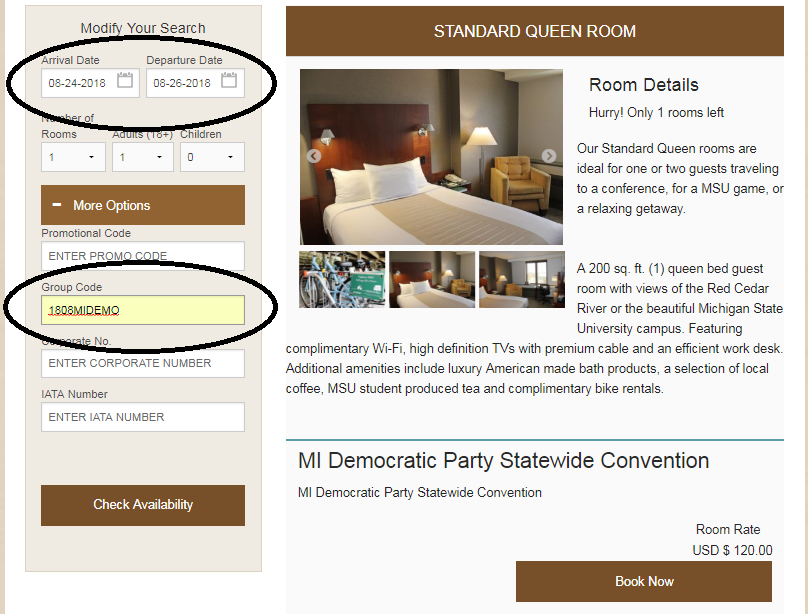
Online Reservation Instructions
For ease and 24 hour access to booking for your guests we encourage guests to book online by following the instructions below:
Click on the “Reservations” link at the top of the page
Select "Book a Room" link
Enter arrival, departure, rooms, and number of adults and children
Select “More Options” and enter your Code for Group Block: 2205STATEC
Click “Check Availability”
For special requests, reservations outside of the conference dates, or reservations after the room block release date, please call our reservations department at 800-875-5090.
Phone Reservation Instructions
Call 800-875-5090 and refer to the Code for Group Block: 2205STATEC or Block Name:CPASW Climate Predication Application
Representatives are available Monday through Friday 7:30am-7:00pm
Event Organizers
Michigan State University
Michigan State Climate Office
National Weather Service, Climate Services Branch
National Centers for Environmental Prediction / Climate Prediction Center
NWS Central Region Headquarters and Detroit Weather Forecast Office
Oceanic and Atmospheric Research / Climate Program Office
National Environmental Satellite, Data, and Information Service / National Centers for Environmental Information