National Weather Service United States Department of Commerce

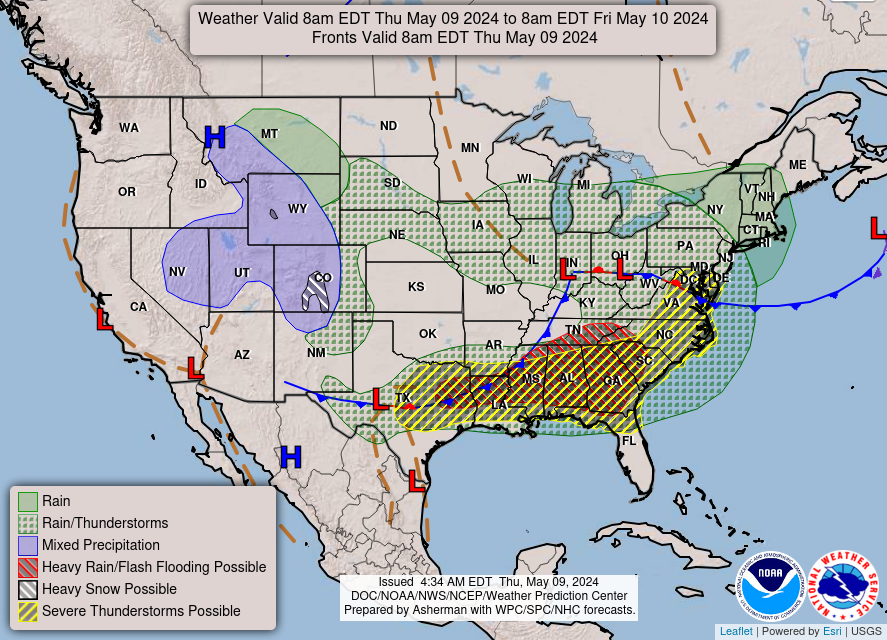
Severe Weather and Heavy Rain in the Southeast; Late-Season Snowstorm in the Central Rockies

Severe thunderstorms across Texas to the southern Appalachians pose risks of damaging winds, large hail, a couple of tornadoes, and potential flooding through Wednesday. A late-season snowstorm will continue to produce heavy snow over parts of the central Rockies, possibly resulting in travel disruptions, downed trees, and power outages. Read More >

On Monday, August 21st, 2017, all of of North America experienced a solar eclipse of the sun.  The path of the total solar eclipse was from the Plateau to much of southeast Tennessee to southwest North Carolina.  The maximum solar eclipse occurred between 233 and 236 pm ET.  Due to the moon’s blockage of the suns solar radiation, temperatures (red line) dropped as much as 10 degrees between 2 and 3 pm Monday afternoon.  However, the temperature drop varied greatly across east Tennessee, southwest Virginia, and southwest North Carolina.  
 
The dewpoint temperature (green line), which is measure of moisture in the air, generally increased during the eclipse.  The graphs below show the different temperature and dewpoint observation traces across southwest Virginia, east Tennessee, and southwest North Carolina.


Eclipse Observed Temperature Curves on Monday, August 21st 2017
 
Athens, TN Temperature Graph
Cleveland, TN Temperature Graph
   
   
Andrews, NC Temperature Graph
Chattanooga, TN Temperature Graph
   
   
Pigeon Forge, TN Temperature Graph
Knoxville, TN Temperature Graph
   
   
Morristown, TN Temperature Graph
Oak Ridge, TN Temperature Graph
   
   
Jacksboro, TN Temperature Graph
Tri-Cities, TN Temperature Graph
   
   
Abingdon, VA Temperature Graph
Wise, VA Temperature Graph