
A Nor'easter well off the East Coast will slowly track north this week and may gain some subtropical characteristics. Strong onshore winds will bring flooding, dangerous marine conditions, and beach erosion along the Mid-Atlantic coast. A Pacific storm is bringing gusty winds, severe thunderstorms, and mountain snow to portions of California and the Southwest U.S. through Thursday. Read More >
Albuquerque, NM
Weather Forecast Office
| Northwestern Plateau |
| December-January-February Precipitation |
|
(Return to Main Feature) or go to CD2 | CD3 | CD4 | CD5 | CD6 | CD7 | CD8 On average, the relationship between El Niño and above normal precipitation in New Mexico is strongest in the southwest corner of the state and weakest in northern portions of the state, particularly along the Colorado border. Our two stations (Aztec Ruins National Monument and Chaco Canyon) in northwest New Mexico support this pattern with a smaller average increase in precipitation of around 120%. For both stations, winter precipitation exhibits a more consistent signal of increased precipitation during El Niño events following the PDO regime shift. A description of the graphs is located at the bottom of the page. |
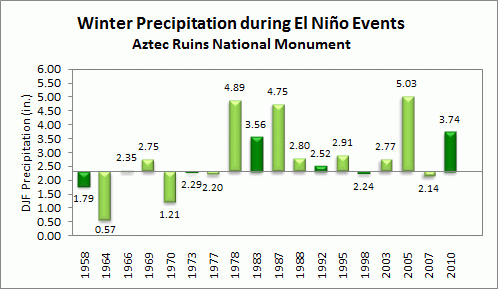 |
| Percent of Longterm Average for all El Niño Events =121% , for strong El Niño Events = 114% |
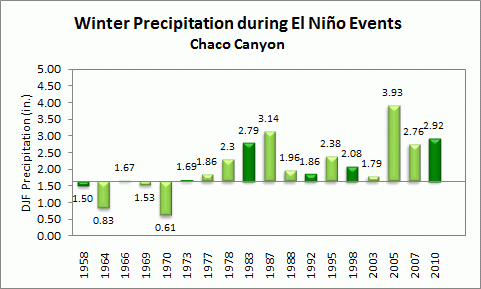 |
| Percent of Longterm Average for all El Niño Events = 127% , for strong El Niño Events = 126% |
|
Precipitation values for 3-month periods during 18 El Niño Events since 1949-50 are plotted with respect to the long term precipitation average, listed to the right of the graph. The precipitation totals for each 3-month period are plotted above or below each bar. Years for which the El Niño Event was considered to be strong are colored in dark green. "M" represents a 3-month period with missing data. Finally, the percents of long term normal for all El Niño events and for the strong El Niño events are listed below each graph. |
Current Hazards
Outlooks
Submit A Storm Report
Severe and Hazardous Weather Info
Current Conditions
Surface Observations
Observed Precipitation
Satellite
Local Satellite Page
Local Observations Page
Map of Latest Wind and Precipitation Reports
Radar
National Radar
ABX Albuquerque Radar
FDX Cannon Air Force Base Radar
Forecasts
Fire Weather Forecasts
Area Forecast Discussion
Hourly View Forecast
Activity Planner
Aviation Forecasts
Local Forecast Page
Graphical Forecasts
Hydrology
Advanced Hydrologic Prediction Services
Local Hydrology Products
Climate and Past Weather
Climate Prediction Center
Climate Graphs
Drought
Severe T-Storm Climatology for NM
Local Data
Winter Climatology for NM
NOAA Climate Center
Local Programs
About Our Office
SKYWARN
NOAA Weather Radio
Local Studies and Features
Winter Weather Info, Safety Tips, and Climo
Severe Weather Info, Safety Tips, and Climo
Center Weather Service Unit

US Dept of Commerce
National Oceanic and Atmospheric Administration
National Weather Service
Albuquerque, NM
2341 Clark Carr Loop SE
Albuquerque, NM 87106-5633
(505) 243-0702
Comments? Questions? Please Contact Us.


 Follow us on X
 Follow us on Facebook
 Follow us on YouTube
 ABQ RSS Feed