Louisville, KY
Weather Forecast Office
 |
|
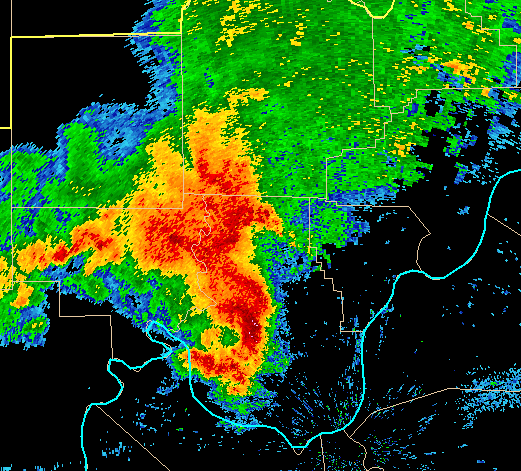
Base reflectivity data at 0.5 degree elevation angle from the KLVX WSR-88D Doppler Radar. Reflectivity shows where and how hard it is raining or snowing, as well as precipitation intensity trends and movement. Blue and green colors represent light-to-moderate rainfall. Yellow and orange colors show moderate-to-heavy precipitation, while red is very heavy rainfall. Above is a close-up view of an arcing line of thunderstorms called a "bow echo" or "bowing line segment" over Harrison County, Indiana (just west of Louisville, Kentucky) on August 13, 2011. The storm produced damaging winds along its path of movement over southern Indiana, and then across Jefferson County (and Louisville), KY, and from there on eastward. Bowman Field Airport (LOU) in Louisville reported a 69 mph wind gust as the line moved through the metro area. NWS forecasters are trained to identify bow echos, which are notorious in producing wind damage in favorable environments. At times, they also can produce transient (brief) tornadoes of EF0-EF2 intensity, although this bow echo produced wind damage only. An event summary on the August 13, 2011 event, including damage photos and radar imagery is available on our Science and Tech site. |
Current Hazards
Hazardous Weather Outlook
Storm Prediction Center
Submit a Storm Report
Advisory/Warning Criteria
Radar
Fort Knox
Evansville
Fort Campbell
Nashville
Jackson
Wilmington
Latest Forecasts
El Nino and La Nina
Climate Prediction
Central U.S. Weather Stories
1-Stop Winter Forecast
Aviation
IDSS Forecast Points
Air Quality
Fire Weather
Recreation Forecasts
1-Stop Drought
Event Ready
1-Stop Severe Forecast
Past Weather
Climate Graphs
1-Stop Climate
CoCoRaHS
Local Climate Pages
Tornado History
Past Derby/Oaks/Thunder Weather
Football Weather
Local Information
About the NWS
Forecast Discussion
Items of Interest
Spotter Training
Regional Weather Map
Decision Support Page
Text Products
Science and Technology
Outreach
LMK Warning Area
About Our Office
Station History
Hazardous Weather Outlook
Local Climate Page
Tornado Machine Plans
Weather Enterprise Resources

US Dept of Commerce
National Oceanic and Atmospheric Administration
National Weather Service
Louisville, KY
6201 Theiler Lane
Louisville, KY 40229-1476
502-969-8842
Comments? Questions? Please Contact Us.


 Weather Story
 Weather Map
 Local Radar
 Follow us on X
 Follow us on Facebook
 Follow us on YouTube
 LMK RSS Feed