The National Weather Service's (NWS) Cooperative Observer Program (COOP) is the nation's largest and oldest weather network. It was established in 1891 to formalize the collection of meteorological observations and establish/record climate conditions in the United States. Our nation has a long history of weather observations. Many citizens including George Washington, Thomas Jefferson, and Benjamin Franklin maintained weather records. Today, more than 11,000 Cooperative Weather Observers across the United States donate more than one million hours each year to collect daily hydrometeorological data.
The Cooperative Observer Program is truly the nation's weather and climate observing network of, by and for the people. Thanks to its dedicated participants, many decades of relatively stable operation, and high station densities in many rural locations, the Cooperative Network has been recognized both as the most comprehensive daily source of U.S. temperature and precipitation data and for establishing an invaluable climate record.
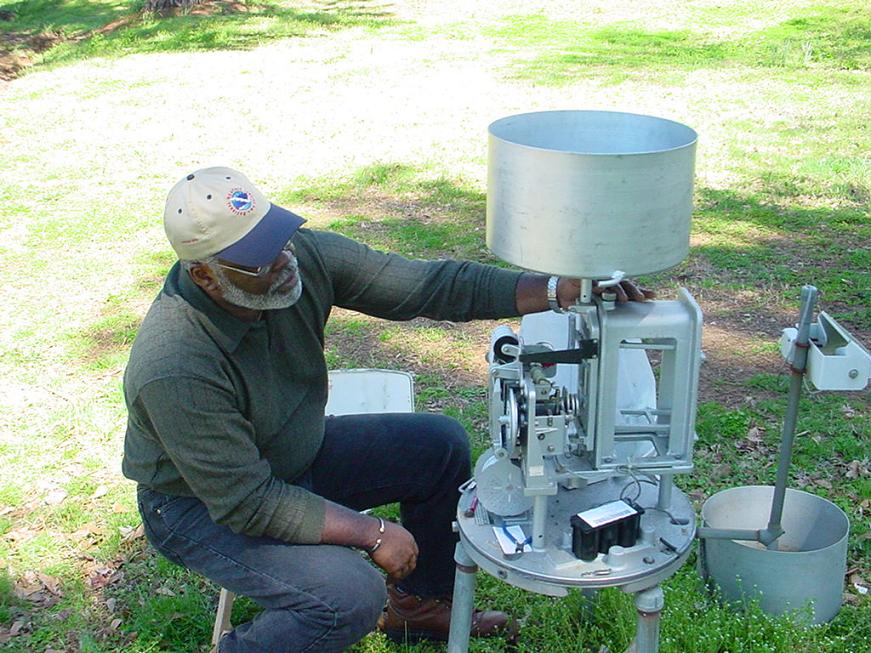
The operations of the COOP program including training, data acquisition, and station management are managed by the NWS. Data processing, including quality control, archiving, and publication, are handled by NOAA's National Climatic Data Center (NCDC). Participants receive a set of simple weather instruments and observing instructions by the NWS. Equipment used at NWS cooperative stations may be owned by the NWS, the observer or by a company or other government agency, as long as it meets NWS equipment standards.
Of the more than 11,000 COOP stations, nearly 5,000 are climate stations (1,200 are Historical Climate Network sites), while more than 6,000 cooperative stations support hydrology requirements. Climate stations report 24-hour maximum and minimum temperatures, liquid equivalent of precipitation, snowfall, snow depth and other special phenomena such as days with thunder, hail, etc. Hydrologic stations, on the other hand, report liquid equivalent of precipitation and may also observe river water level heights, 24-hour maximum and minimum temperature, snowfall, snow depth, evaporation and other parameters. Observations are sent as monthly reports to the NCDC in Asheville, N.C. or to the local NWS forecast office where the data is digitized, checked and archived (i.e., about 5,800 COOP stations have their monthly summaries published by NOAA's NCDC. Several thousand observers also report 24-hour summaries of observations to the NWS on a daily basis). Data is transmitted through telephone, computer or mail.
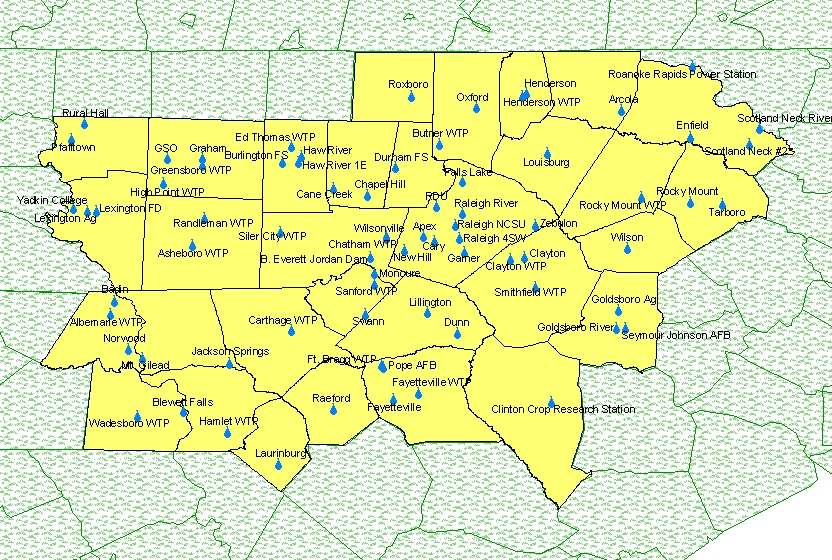
There are 75 cooperative observers in the Raleigh County Warning area. The map below shows the locations and station names of the cooperative observers in the Raleigh forecast area, click on the map to open a larger image.



 Radar
Radar Current Weather
 Rivers & Lakes
 Satellite
 Forecast Maps
 Hour by Hour Forecast
 Graphical Hazards
 Winter Weather
 Climate Plots
 Fire Weather
 Drought Information
 Weather Hazard Briefing
 Statewide Maps
 Forecaster Discussion
 Text Bulletins
 SKYWARN
 Follow us on X
 Follow us on Facebook
 Follow us on YouTube
 RAH RSS Feed