
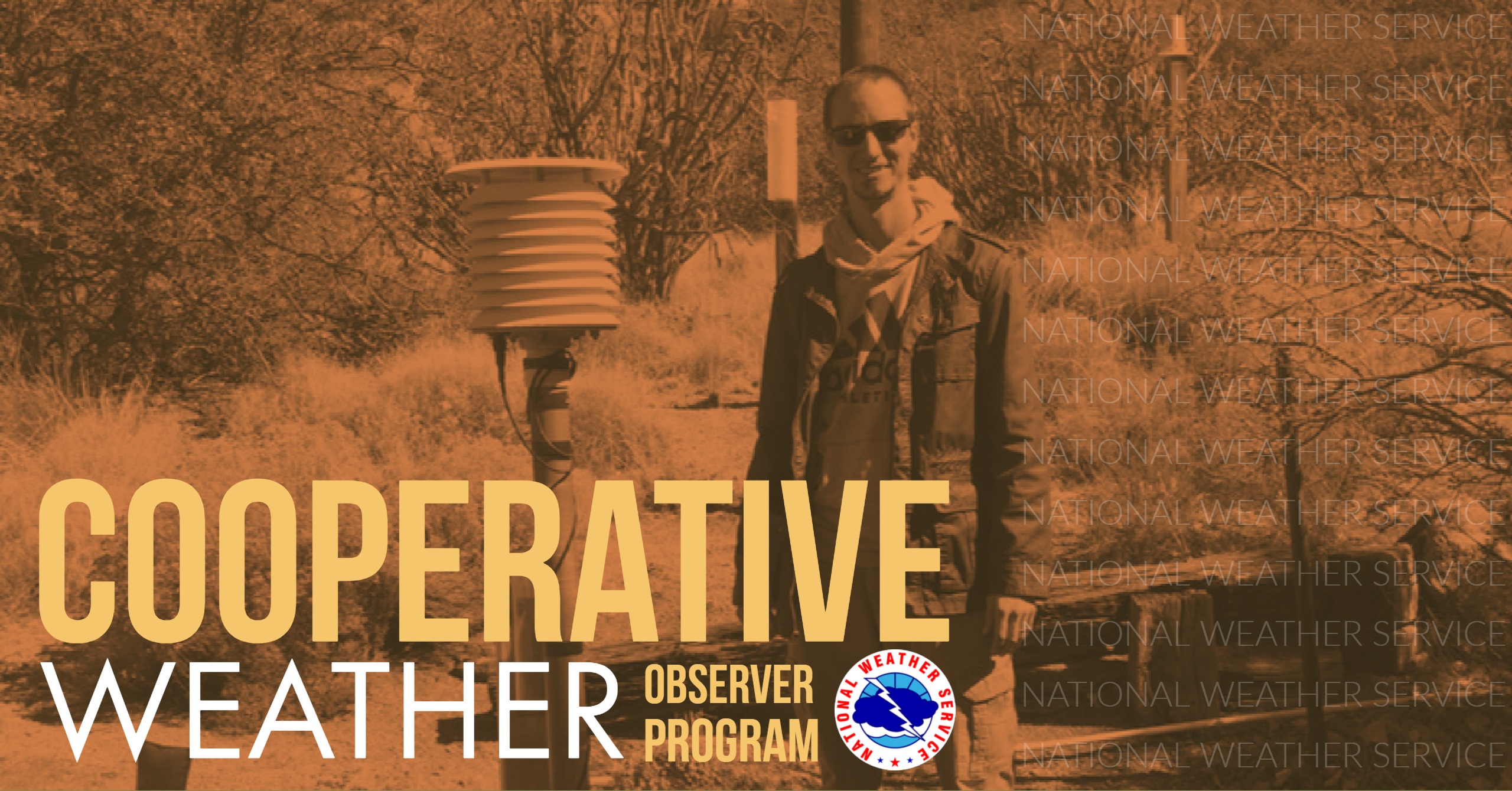
The Cooperative Weather Observer Program (COOP) is a unique partnership between the National Weather Service and citizen volunteers in every U.S. state and territory. This successful program has been around for more than 120 years, and it provides the nation with a cost-effective way to collect weather data for immediate forecasting needs and longer-term national, regional, and local climate outlooks.
Program HistoryThe program’s origins date back to 1890 with the Congressional passage of the National Weather Service Organic Act, which set up a system to recruit and train volunteers across the United States to become cooperative weather observers. However, many COOP stations began operation long before that time. John Campanius' weather records, taken without the benefit of instruments in 1644-45, were the earliest known observations in the United States. Subsequently, many people maintained detailed weather records, including historical figures such as George Washington, Thomas Jefferson, and Benjamin Franklin. Thomas Jefferson maintained an almost unbroken record of weather observations between 1776 and 1816, and George Washington took his last observation just a few days before he died. Cooperative weather observers volunteer their time to record and report weather and climate observations to the National Weather Service on a daily basis, observing daily maximum and minimum temperatures, rain and snowfall totals, and more. The data is used to support daily weather forecasts and warnings, and it continues to help build the nation’s historic climate record. |
 |
Today, volunteers record weather and climate data at almost 8,500 sites throughout the 50 U.S. states and its territories. The federal government provides observers with free training and equipment to set up their weather station. The National Weather Service offers additional support through equipment maintenance and site visits. The observers contribute a great public service to local communities and to the nation by checking their weather instruments daily and submitting the data over the internet. The data is then quality controlled and published online for public use.
All of the nearly 8,500 observing sites support local weather, climate and flood forecasts. Additionally, data from a select number of stations (1,229) also contribute to the U.S. regional climate record. These sites, called the U.S. Historical Climatology Network (USHCN), were selected for their longstanding and unbroken record along with their static site location of at least 80 years. Across the planet, up to 100,000 stations make up the Global Historical Climatology Network (GHCN).
Up to 26 types of weather measurements are reported by observers, including soil temperature, evaporation, snowfall and liquid equivalent precipitation. Cooperative observer datasets represent some of the few sources of snowfall measurements and its liquid equivalency in the United States. Historical weather averages for all areas of the country are often determined using observer data. Observer datasets help settle billions of dollars annually in insurance and legal claims, determine federal disaster declarations for federal aid to local counties and are a major factor in determining household energy costs. These datasets play a critical role in efforts to determine and evaluate the extent of the evolution of the climate from local to global scales. In addition, data collected by weather observers help local officials make long-term planning decisions about water resources and are used by a variety of industries on a daily basis, including medical, transportation, agriculture, engineering and communication.



 Follow us on X
 Follow us on Facebook
 Follow us on YouTube
 ABQ RSS Feed