
|
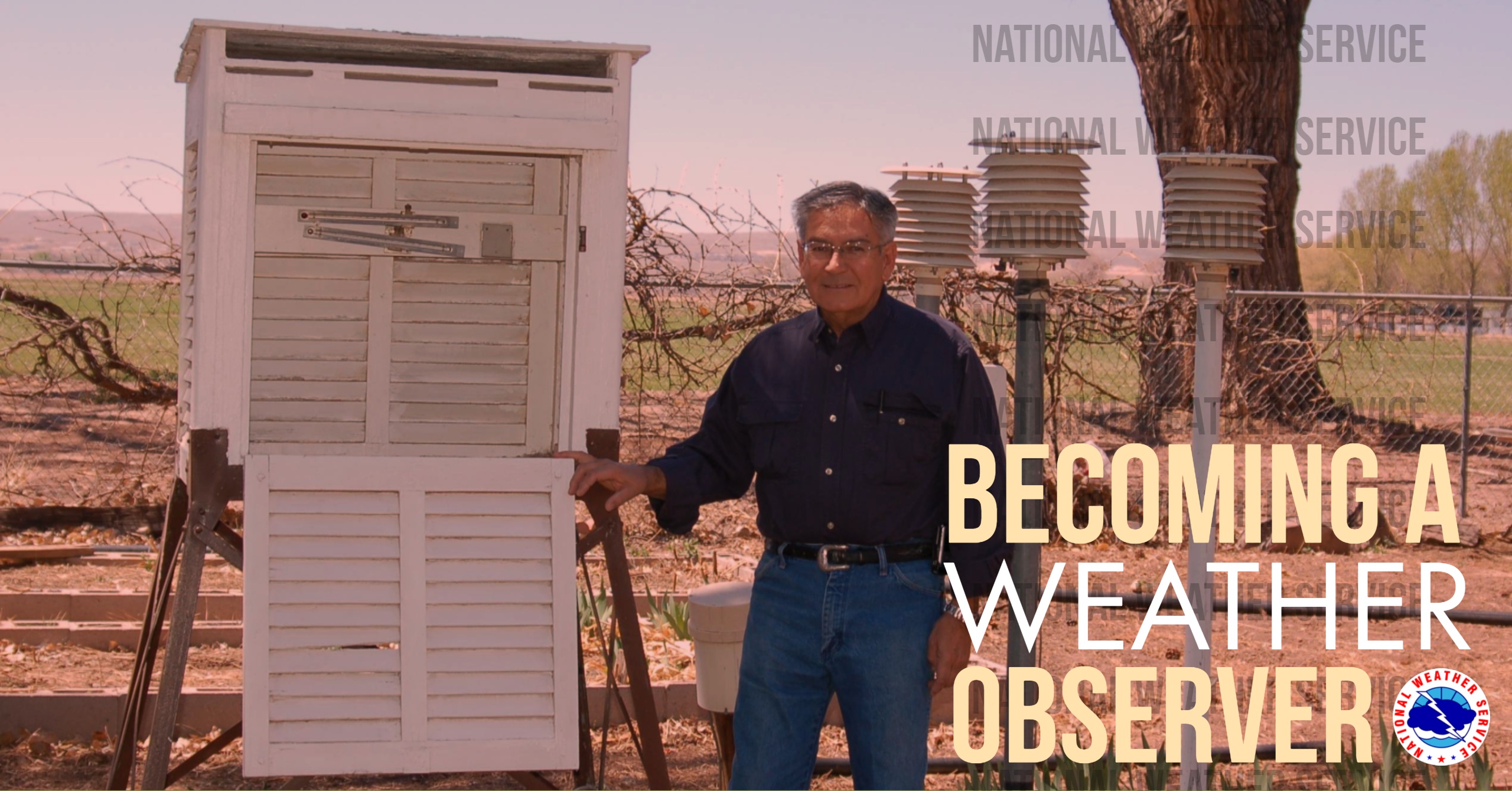
Are you interested in becoming an official weather observer? Several unique opportunities exist for weather observers in New Mexico. Each one is described below in more detail. |
|||
|
Cooperative weather observers, part of the Cooperative Observer Program (COOP), generally record temperature and precipitation daily and electronically send those reports to the National Weather Service (NWS) and the National Climatic Data Center (NCDC). Many COOP observers provide additional hydrological or meteorological data, such as evaporation or soil temperatures. Datasets are then transmitted to the NWS via internet. Equipment used at the NWS cooperative stations is typically owned by the NWS, and requires a small, unobstructed space that can be dedicated to house the NWS instrumentation. See our proper siting requirements for further details. There is no requirement to take any tests to become a COOP observer, but every prospective observer needs to demonstrate a willingness to dedicate a few minutes each day to recording weather data while assuring its quality and accuracy. Volunteer weather observers conscientiously contribute their time so that observations can provide the vital information needed. These datasets are invaluable in learning more about the floods, droughts, heat and cold waves affecting us all. The datasets are also used in agricultural planning and assessment, engineering, environmental-impact assessment, utilities planning, and litigation. COOP weather observer data plays a critical role in efforts to recognize and evaluate the extent of human impacts on weather and climate from local to global scales.
The specific requirements for COOP observers include the following:
If you are selected to become an official COOP station, the NWS will provide you with the training and support needed. Depending on your station's instrumentation, your site will typically be visited once or twice every 12 months. Unfortunately, volunteers are not paid except in a few very specific situations. Using a website known as WxCoder, observers send daily high and low temperatures, as well as 24-hour precipitation totals directly to the NWS. At the beginning of the month, the previous month's data is finalized by both the observer and the NWS. These datasets are quality controlled and then sent to NCDC, where they are finalized and collectively made part of the official national climate database.
|
|||
 |
|||
|
The National Weather Service office in Albuquerque issues forecasts, weather statements, and warnings for the northern two-thirds of New Mexico where a wide variety of extreme weather occurs throughout the year. Reports from volunteer storm spotters improve our weather statements, advisories, warnings, and other services in a number of ways.
Due to the rural nature of New Mexico, our current observation network lacks the spatial resolution necessary to adequately cover the state. Observers are often clustered around cities and major highways, with many areas void of weather data. Weather radars also have limitations, as the radar beams are commonly blocked by the high elevation mountains, and other large gaps in radar coverage also exist due to the size of our large state. Enter SKYWARN storm spotters, vital assets that can provide real-time ground truth information to meteorologists! This SKYWARN network of storm spotters is independent of the COOP, but many COOP stations are also storm spotters. Storm spotters report tornadoes, funnel clouds, hail, strong winds, flooding, snowfall, ice accumulation, and any hazardous weather causing injury, death or damage. Spotters can use a storm report form on our webpage. Please note, however, you will be required to attend a SKYWARN spotter training course developed by the NWS. It takes about 2.5 hours to complete. Check our our SKYWARN page for the latest list of training sessions in your area.
|
|||
 |
|||
The Community Collaborative Rain, Hail and Snow Network (CoCoRaHS, pronounced KO-ko-rozz) began in Colorado in 1998 as a result of the Fort Collins flood in 1997. This supplemental network allows volunteer weather observers to enter rainfall, snowfall, hail and snow reports into a web-based system. The result is displayed on maps and can be accessed by anyone with Internet capabilities. The near real-time data from CoCoRaHS observers can provide valuable information to meteorologists as they fine-tune their forecasts and make critical decisions about weather warnings. CoCoRaHS is not intended to replace the COOP, but rather to supplement it. CoCoRaHS precipitation data helps scientists fill in the gaps, and ultimately this paints a better picture of observed rain, hail, and snowfall. All you need to join is a rain gauge, internet access, and a willingness to volunteer your precise precipitation observations on a consistent basis. For more information on this network and the training session, see the CoCoRaHS web page: http://www.cocorahs.org/. |
|||



 Follow us on X
 Follow us on Facebook
 Follow us on YouTube
 ABQ RSS Feed