
Isaias is expected to strengthen and be a strong hurricane when it approaches the northern Gulf Coast on Friday. Damaging hurricane-force winds and life-threatening storm surge impacts are expected Friday into Saturday. Isaias will bring heavy rainfall to the northern Gulf Coast and much of the Southeast U.S. Friday into the weekend. Read More >
Western and Central Wyoming
Weather Forecast Office
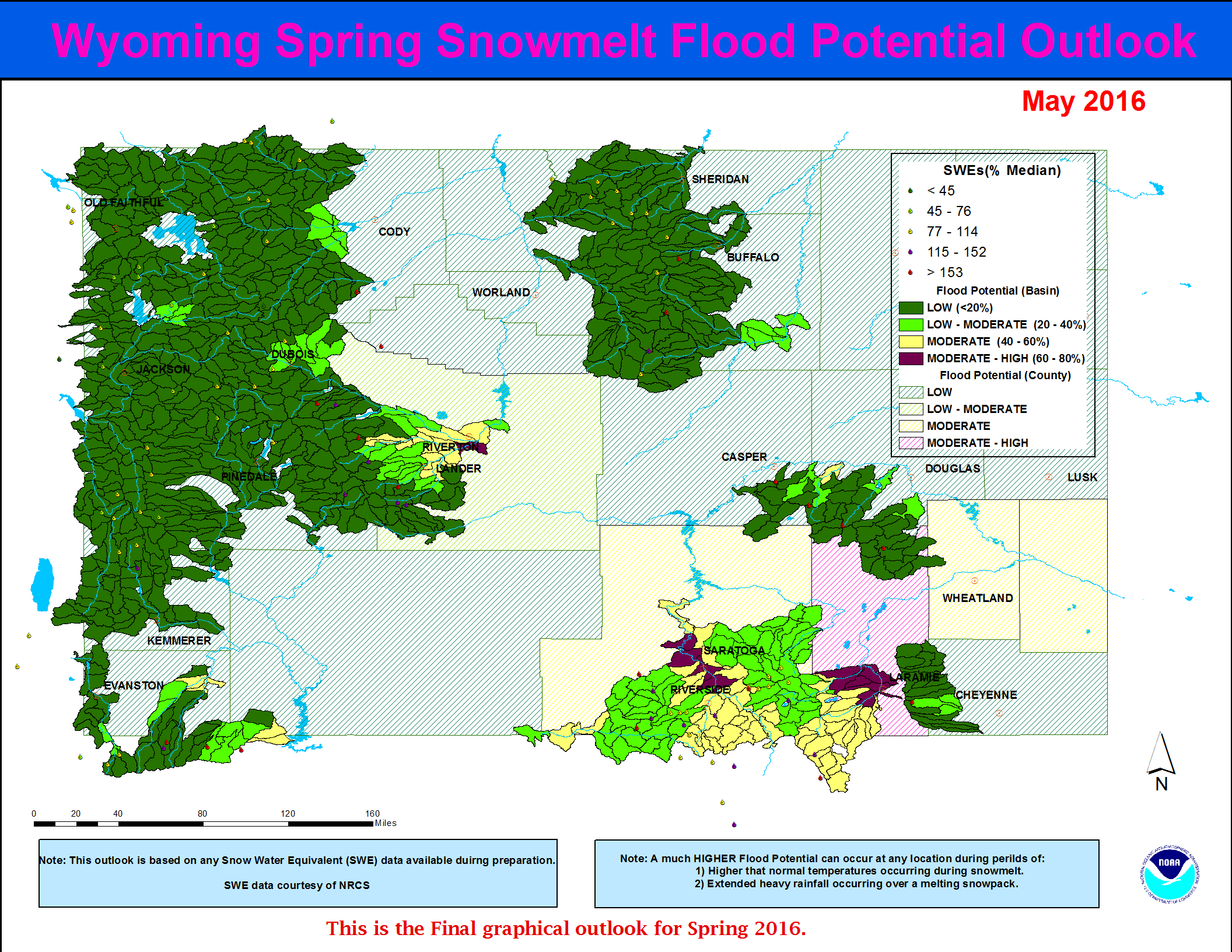
…Moderate to High potential for snowmelt runoff flooding is forecasted along the lower portions of the Laramie Watershed (near Laramie)…
…Moderate potential for snowmelt runoff flooding is forecasted along the lower portions of the Upper North Platte River Basin (near Saratoga) and along the lower portions of the Little Snake Watershed (near Dixon/Baggs)…
…All other of headwater basins across Wyoming can expect a generally Low potential for flooding due to springtime snowmelt runoff...
Mountain snowpack and associated snow water equivalents (SWEs) across most of Wyoming continued to be generally above average by the middle of April. SWEs at the peak snowmelt runoff elevations (8,500’ – 10,000’) were the highest across the Little Snake, Upper North Platte, Laramie, and Snake Basins at 120 to 130 percent of median. The Tongue, Bighorn, and Powder Watersheds had SWEs at 80 to near 90 percent of median at the peak snowmelt runoff elevations.
This outlook is based on various diverse hydrological factors such as snow water equivalents (SWEs) in the mountain snowpack, basin morphology (i.e. how basins respond to snowmelt runoff), antecedent soil moisture, biological/physical factors (bark beetle kill/spruce blight///fire burn scars), low elevation snow depths, and likely temperature and precipitation trends during late spring/early summer.
The current Wyoming Spring 2019 Snowmelt Runoff Flood Potential Outlook graphic:
Forecasts
Severe Weather
Forecast Discussion
User Defined Forecast
Fire Weather
Activity Planner
Hourly Forecasts
Snow and Avalanche
Aviation Weather Decision Support
Hydrology
SnoTel Page
Rivers and Lakes
Weather Safety
NOAA Weather Radio
Preparedness
SkyWarn
StormReady

US Dept of Commerce
National Oceanic and Atmospheric Administration
National Weather Service
Western and Central Wyoming
12744 West U.S. Hwy 26
Riverton, WY 82501
307-857-3898
Comments? Questions? Please Contact Us.


 Follow us on X
 Follow us on Facebook
 Follow us on YouTube
 RIW RSS Feed