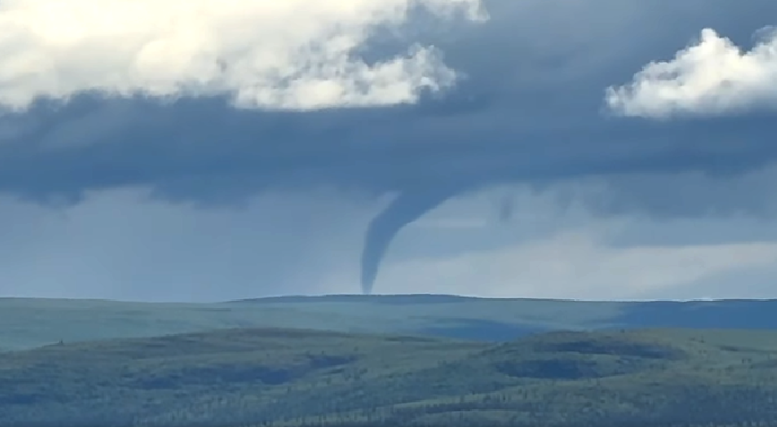
A weak thunderstorm that moved over a remote area south of the Denali Highway generated quite a bit of attention when it produced a funnel cloud that was visible from the Alpine Creek Lodge, reportedly lasting for around 10 to 15 minutes during the late afternoon on the 4th of July this year. Here is snapshot of what viewers captured from the ground:
Was this a tornado?
The short answer is that we don’t have enough evidence to say that it was one. While it may appear that the funnel cloud was touching the ground in some of the photos and videos received, there is a ridgeline in the foreground and a valley that dips down right around the area the funnel cloud was located based on satellite and radar data of the parent storm near the time of the initial report. Thus, it is not entirely clear whether the funnel cloud actually extended all the way down to the surface. In addition, the thunderstorm that produced this funnel was very weak, low-topped and produced almost no lightning. If new evidence comes to light that clearly shows the funnel reaching the ground or debris being kicked up on the ground under the funnel, the event could still be reclassified.
What is the difference between a funnel cloud, dust devil, tornado and waterspout?
A tornado is a rotating column of air that extends from the base of a cloud all the way to the ground. They are usually associated with rotating thunderstorms called supercells, but not always. They are often accompanied by a cloud (condensation funnel) that extends partway or all the way to the ground. Certain conditions can cause tornadoes to form from a parent cloud base that is not part of a rotating thunderstorm. These are often referred to as “landspout” tornadoes. Several of the handful of documented tornadoes in Alaska fall into this category.
A funnel cloud is a rotating cloud descending from the base of a shower or thunderstorm that does not reach all the way to the ground. While they look threatening and can absolutely be a hazard for aircraft, they are harmless to anyone standing at ground level.
A waterspout is exactly the same thing as a tornado, except that it forms over a body of water instead of over land. These can be quite dangerous to mariners in the area when they develop.
A dust devil is a rotating column of air that forms at the ground level when the sun heats the earth’s surface and causes air to rise unevenly, sometimes creating small areas of wind shear combined with converging air currents that cause these features to form. They are not associated with thunderstorms and do not extend up to a cloud base, but can still be strong enough to cause minor damage to vulnerable structures. In fact, these are most common to see on hot, sunny days!
Are tornadoes and funnel clouds happening in Alaska more often?
Most likely, there is no actual increase in the occurrence of these events. However, the frequency of reports has been trending up in recent decades during the summer months due to the increase in visitors able to take pictures of funnel clouds with cell phones and the ability to easily spread reports on social media.
Officially, there have been a total of 8 tornadoes and 33 funnel clouds documented (see table below) in Alaska since about 1950. We are well aware that this is far from a complete list of every sighting that has surfaced over the years. Our lack of radar coverage and complex terrain makes documenting these events especially challenging across Alaska!




 Follow us on X
 Follow us on Facebook
 Follow us on YouTube
 AFC RSS Feed