According to the National Snow and Ice Data Center:
Icebergs are large floating chunks of ice, detached from a glacier, such as an alpine glacier or ice sheet, and carried out to a lake or the ocean. The word iceberg literally means ice mountain, berg borrowed from German.
Icebergs come in all shapes and sizes, from ice-cube-sized chunks to ice islands the size of a small country. The term “iceberg” refers to chunks of ice larger than 5 meters (16 feet) across. Smaller icebergs, known as bergy bits and growlers, can be especially dangerous for ships because they are harder to spot.
Icebergs are created through a process called calving. As a glacier or ice shelf flows into the ocean, the weight of the ice combined with the action of tides and waves causes large chunks to crack and break away
An ice island is a massive, tabular (flat-topped) piece of floating ice that has broken off from an ice shelf or ice tongue. While they are technically a type of iceberg, they are distinguished by their immense size, their origin, and their specific formation process.
In the Arctic, the term "ice island" is used specifically to describe these giant slabs that calve from ice shelves or (the floating extensions of land-based glaciers) or ice tongues, most notably from Ellesmere Island in Canada and parts of Greenland.
While all ice islands are icebergs, not all icebergs are ice islands. The main differences are:
Source: Regular icebergs usually calve from glaciers (moving rivers of ice). Ice islands calve from ice shelves (thick, floating platforms of ice attached to the coast).
Shape: Most icebergs are "non-tabular" (peaked, domed, or irregular). Ice islands are always "tabular" (flat and shelf-like).
An iceberg grounded amongst the shorefast ice near Utqiagvik, Alaska. From: International Arctic Buoy Programme
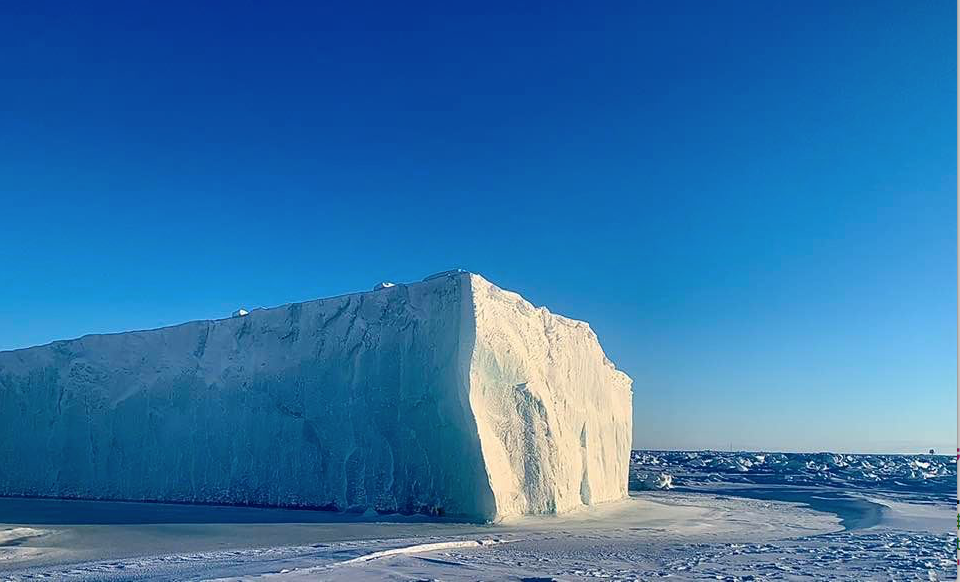

A large 1x5km iceberg in the Beaufort Sea.

Image attribution: Michael Lawson/Alaska Sea Ice Program
One of these shelves, The Milne Ice Shelf on Ellesmere Island on the Canadian Archipelago.


The collapse event resulted in two large ice islands measuring 21 square miles and 9 square miles with numerous smaller icebergs. These initial ice islands were 260 ft thick! These ice islands broke up over time, introducing many icebergs to Alaskan waters of the Beaufort and Chukchi Seas.
Documented breakup events across Ellesmere Island have occurred in 2003, 2005, 2008, 2011 and 2012, and 2020.

Image attribution: Benjamin J. Burger, CC BY-SA 4.0 <https://creativecommons.org/licenses/by-sa/4.0>, via Wikimedia Commons
.png/Ice_Islands_2025(1)__600x600.png)




 Follow us on X
 Follow us on Facebook
 Follow us on YouTube
 AFC RSS Feed