
Current Watches, Warnings, and
Advisories

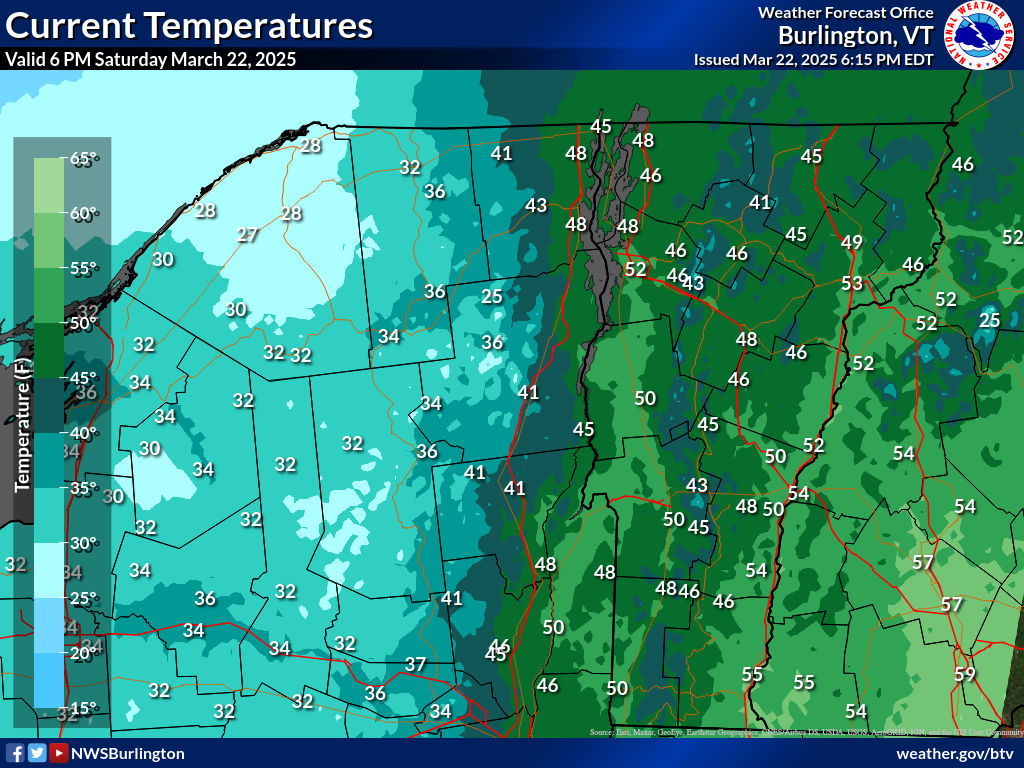
Current Temperatures
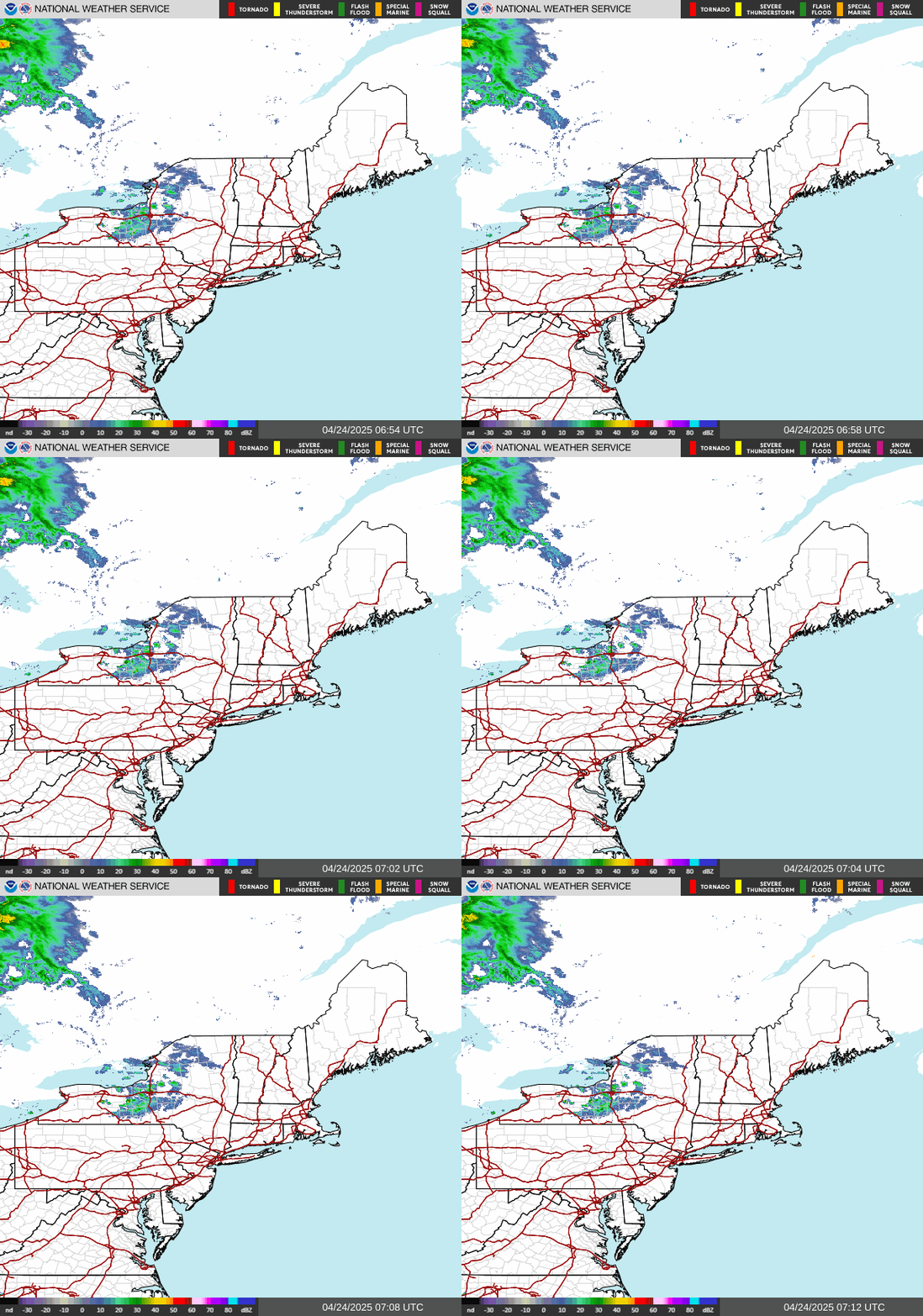
Current Radar
Current Visible Satellite Loop

Current Temperatures
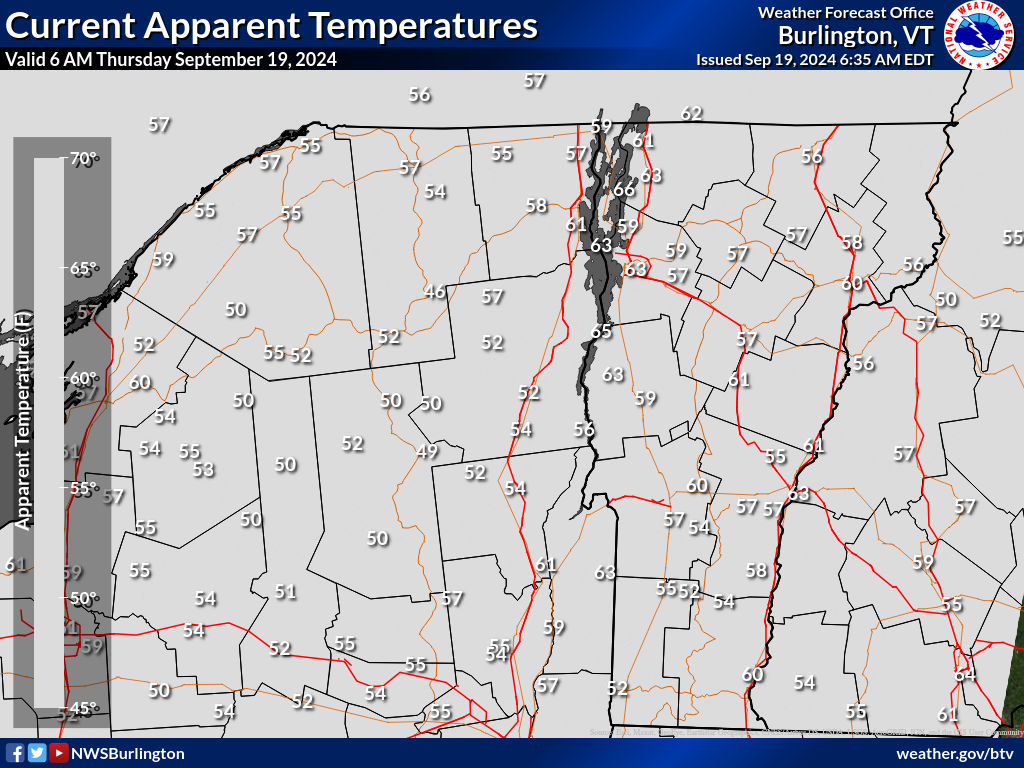
Current Heat Index
Temperatures
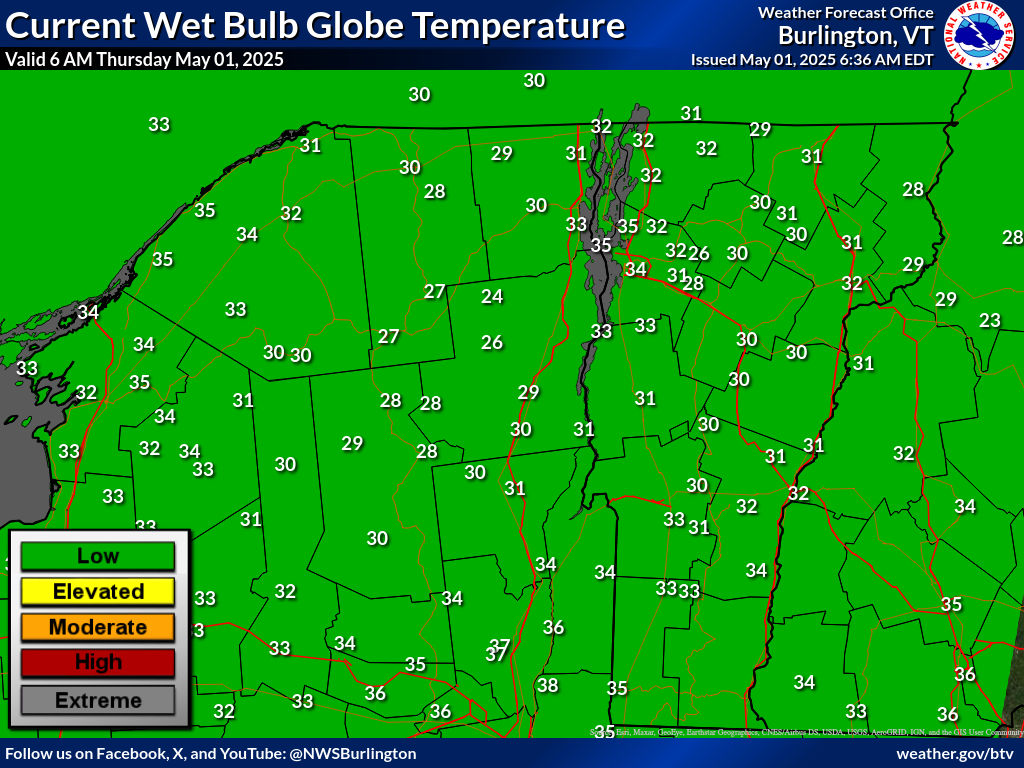
Current Wet Bulb Globe
Temperatures
Today's Hourly Heat Index Forecasts
Tomorrow's Hourly Heat Index Forecasts
Daily Heat Index Forecasts
Max Temperature vs Heat Index
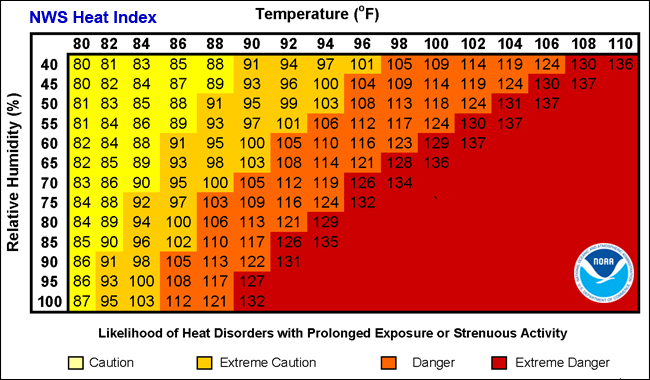
The Heat Index is a measure of how hot it really feels when relative humidity is
factored in with the actual air temperature. To find the Heat Index temperature, look at
the Heat Index Chart above or check our Heat Index Calculator.
As an example, if the air temperature is 96°F and the relative humidity is 65%, the
heat index--how hot it feels--is 121°F. The red area without numbers indicates
extreme danger. The National Weather Service will initiate alert procedures when the
Heat Index is expected to exceed 105°-110°F (depending on local climate) for at
least 2 consecutive days.
Compare the Max Temperature and Heat Index
Click the thumbnails below to view larger image.
Wet Bulb Globe Temperature (WBGT)
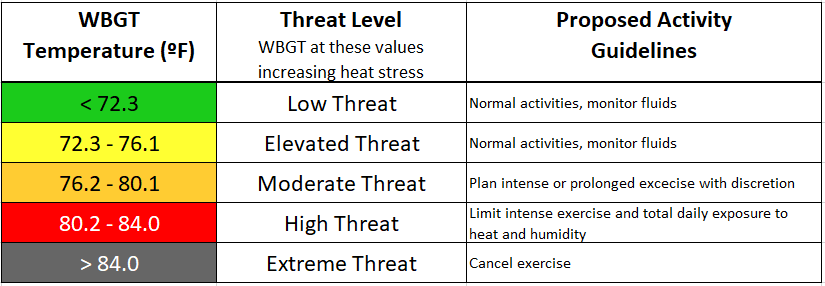
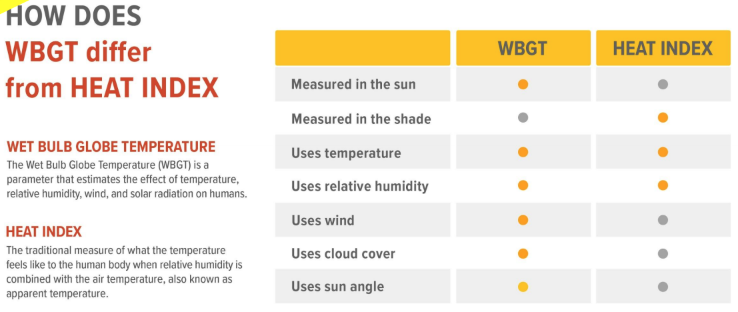
(Experimental) National WBGT DisplayThe Wet Bulb Globe Temperature (WBGT) is a measure of heat stress in
direct sunlight, which is based on temperature, humidity, wind speed, sun angle, and
cloud cover (solar radiation). This differs from the heat index, which is based only on
temperature and humidity and is calculated for shady areas. Scroll down for latest
forecasts.
Hourly WBGT Forecast
Daily WBGT Forecast
Resources
- General WBGT Information (Wiki page)
- American College of Sports Medicine (ACSM), [position stand]
- Korey Stringer Institute
- University of Georgia Research [AMS conference presentation]
- WBGT Research
- OSHA Heat Hazard Assessment and WBGT
- Department of the Army: Prevention of Heat and Cold Casualties
- Department of the Army: WBGT, Guidelines, Prevention
WBGT vs Heat Index
What's the Difference?
Compare the WBGT and Heat Index
Click the thumbnails below to view larger image.
NWS HeatRisk
(Experimental) National HeatRisk DisplayThe NWS HeatRisk is an experimental color-numeric-based index that
provides a forecast risk of heat-related impacts to occur over a 24-hour period.
HeatRisk takes into consideration:
- How unusual the heat is for the time of the year
- The duration of the heat including both daytime and nighttime temperatures
- If those temperatures pose an elevated risk of heat-related impacts based on data from the CDC
| Category | Risk of Heat-Related Impacts |
|---|---|
| Green 0 |
Little to no risk from expected heat. |
| Yellow 1 |
Minor - This level of heat affects primarily those individuals extremely sensitive to heat, especially when outdoors without effective cooling and/or adequate hydration. |
| Orange 2 |
Moderate - This level of heat affects most individuals sensitive to heat, especially those without effective cooling and/or adequate hydration. Impacts possible in some health systems and in heat-sensitive industries. |
| Red 3 |
Major - This level of heat affects anyone without effective cooling and/or adequate hydration. Impacts likely in some health systems, heat-sensitive industries and infrastructure. |
| Magenta 4 |
Extreme - This level of rare and/or long-duration extreme heat with little to no overnight relief affects anyone without effective cooling and/or adequate hydration. Impacts likely in most health systems, heat-sensitive industries and infrastructure. |
Daily HeatRisk
Heat Safety
 |
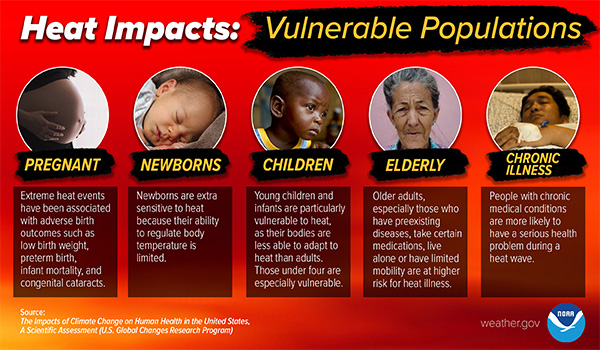 |
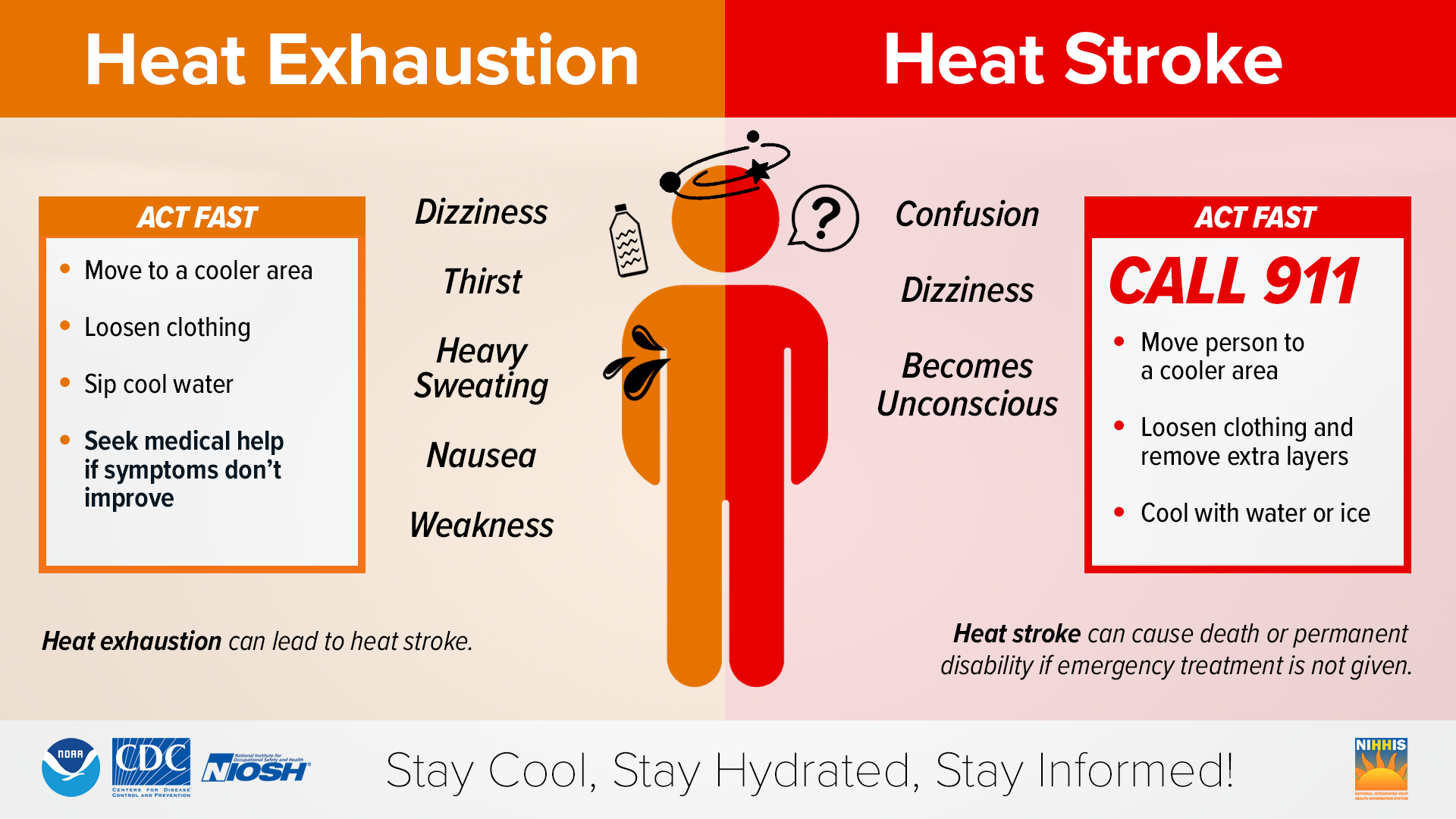
During extremely hot and humid weather, your body's ability to cool itself is challenged. When the body heats too rapidly to cool itself properly, or when too much fluid or salt is lost through dehydration or sweating, body temperature rises and you or someone you care about may experience a heat-related illness. It is important to know the symptoms of excessive heat exposure and the appropriate responses. The Centers for Disease Control and Prevention (CDC) provides a list of warning signs and symptoms of heat illness, and recommended first aid steps. Some of these symptoms and steps are listed below.
Heat Cramps
Heat cramps may be the first sign of heat-related illness, and may
lead to heat exhaustion or stroke.
- Symptoms: Painful muscle cramps and spasms usually in legs and abdomen and Heavy sweating.
- First Aid: Apply firm pressure on cramping muscles or gently
massage to relieve spasm. Give sips of water unless the person complains of
nausea, then stop giving water.
Seek immediate medical attention if cramps last longer than 1 hour.
Heat Exhaustion
- Symptoms: Heavy sweating, Weakness or tiredness, cool, pale, clammy skin; fast, weak pulse, muscle cramps, dizziness, nausea or vomiting, headache, fainting,
- First Aid: Move person to a cooler environment, preferably a
well air conditioned room. Loosen clothing. Apply cool, wet cloths or have
person sit in a cool bath. Offer sips of water. If person vomits more than
once,
Seek immediate medical attention if the person vomits, symptoms worsen or last longer than 1 hour
Heat Stroke
- Symptoms: Throbbing headache, confusion, nausea, dizziness, body temperature above 103°F, hot, red, dry or damp skin, rapid and strong pulse, fainting, loss of consciousness.
- First Aid: Call 911 or get the victim to a hospital immediately. Heat stroke is a severe medical emergency. Delay can be fatal. Move the victim to a cooler, preferably air-conditioned, environment. Reduce body temperature with cool cloths or bath. Use fan if heat index temperatures are below the high 90s. A fan can make you hotter at higher temperatures. Do NOT give fluids.
Resources
- NWS Heat Safety Tips and Resources
- NWS Heat Safety Brochure
- NWS Heat Safety (One Pager)
- Vermont Department of Health Hot Weather and Health Impacts
- New York Department of Health - Extreme Heat Advice
- FEMA's Extreme Heat
- CDC Guide to Extreme Heat
- American Red Cross Heat Wave Safety
- Occupational Safety and Health Administration
- National Highway Traffic Safety Administration
Today's Hourly Wind Chill Forecasts
Tomorrow's Hourly Wind Chill Forecasts
Daily Wind Chill Forecasts
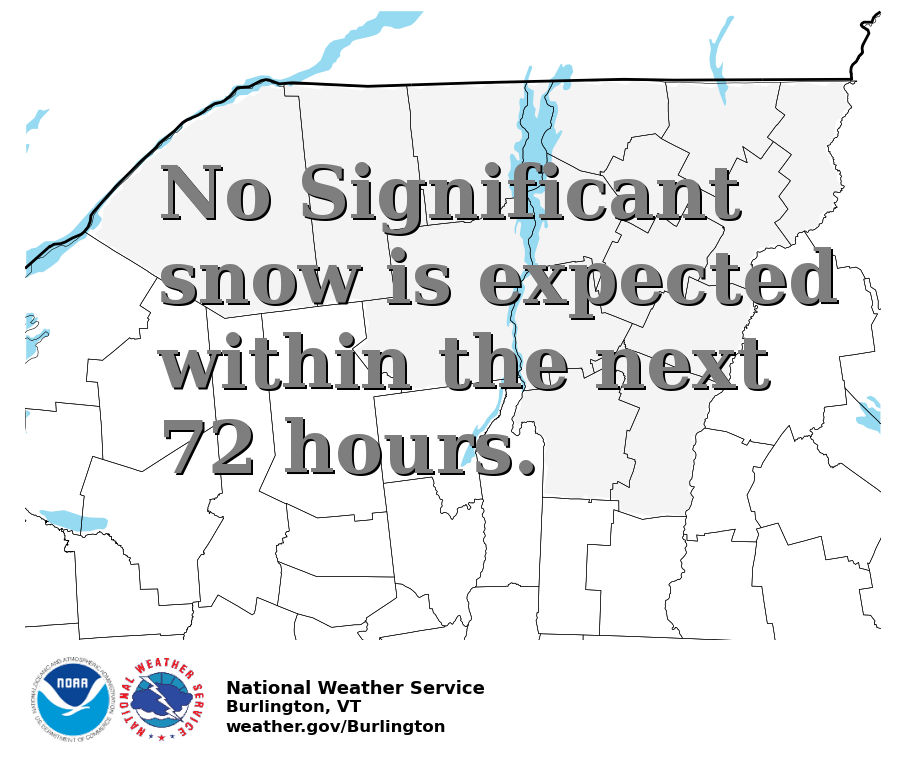
Event Total Snowfall - Official NWS Forecast
The map below represents the expected average accumulation. Some
locations will receive less snow, while others will receive more. In addition, the
"Event Total" time range may differ from the time range of the "Expected
Snowfall" on the Probabilistic Snowfall Forecast tab (right), which covers a
72-hour period. Reference the subtitle on the "Event Total" graphic for the
time period covered.
Snow Amount Potential
The purpose of these probabilistic
snowfall products is to provide customers and partners a range of snowfall possibilities, in
complement to existing NWS deterministic snowfall graphics, to better communicate forecast
uncertainties during winter weather events. For more information visit this project's
Product/Service Description Document, and please provide us your feedback here.
Percent Chance That Snow Amounts Will Be Greater Than...
Hover over thumbnails below to view larger image.
What's this?
>=0.1"
>=1"
>=2"
>=4"
>=6"
>=8"
>=12"
>=18"
Snowfall Totals by Location
These tables show the snow amount forecast for individual locations.
The tables provide the same information as the maps on this web page, just shown in a
different way. The "Exceedance" option shows the chance that snowfall will
exceed a certain threshold. The "Range" option shows the likelihood of
snowfall being within a certain range. All of these values are valid for the same time
period as depicted on the graphics.
What's
this?
| Location |
Low-End Amount |
Expected Amount |
High-End Amount |
Chance of Seeing More Than | |||||||||
|---|---|---|---|---|---|---|---|---|---|---|---|---|---|
Ice Accumulation Potential
The purpose of these probabilistic ice
accumulation products is to provide customers and partners a range of ice accumulation
possibilities, in complement to existing NWS deterministic ice accumulation graphics, to better
communicate forecast uncertainties during winter weather events. For more information visit this
project's Product/Service Description Document, and please provide us your feedback here.
Percent Chance That Snow Amounts Will Be Greater Than...
Hover over thumbnails below to view larger image.
What's this?
>=0.01"
>=0.1"
>=0.25"
>=0.5"
>=0.75"
>=1"
>=1.25"
>=1.5"
Ice Accumulation Totals by Location
These tables show the snow amount forecast for individual locations.
The tables provide the same information as the maps on this web page, just shown in a
different way. The "Exceedance" option shows the chance that ice accumulation
will exceed a certain threshold. The "Range" option shows the likelihood of
ice accumulation being within a certain range. All of these values are valid for the
same time period as depicted on the graphics.
What's
this?
| Location |
Low-End Amount |
Expected Amount |
High-End Amount |
Chance of Seeing More Than | |||||||||
|---|---|---|---|---|---|---|---|---|---|---|---|---|---|
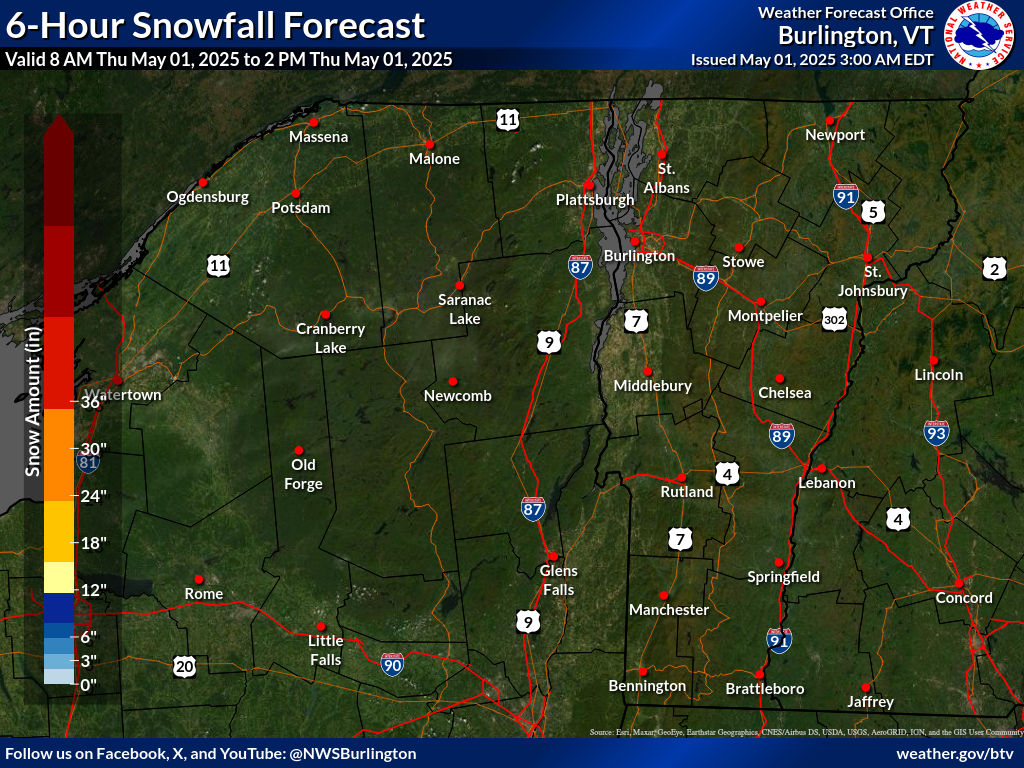
6-Hour Snowfall Forecasts
These maps are official NWS snowfall forecasts in inches for 6-hour
times periods as shown on the graphics. This snowfall amount is determined by NWS
forecasters to be the most likely outcome based on evaluation of data from computer
models, satellite, radar, and other observations.
Hover over thumbnails below to view larger image.


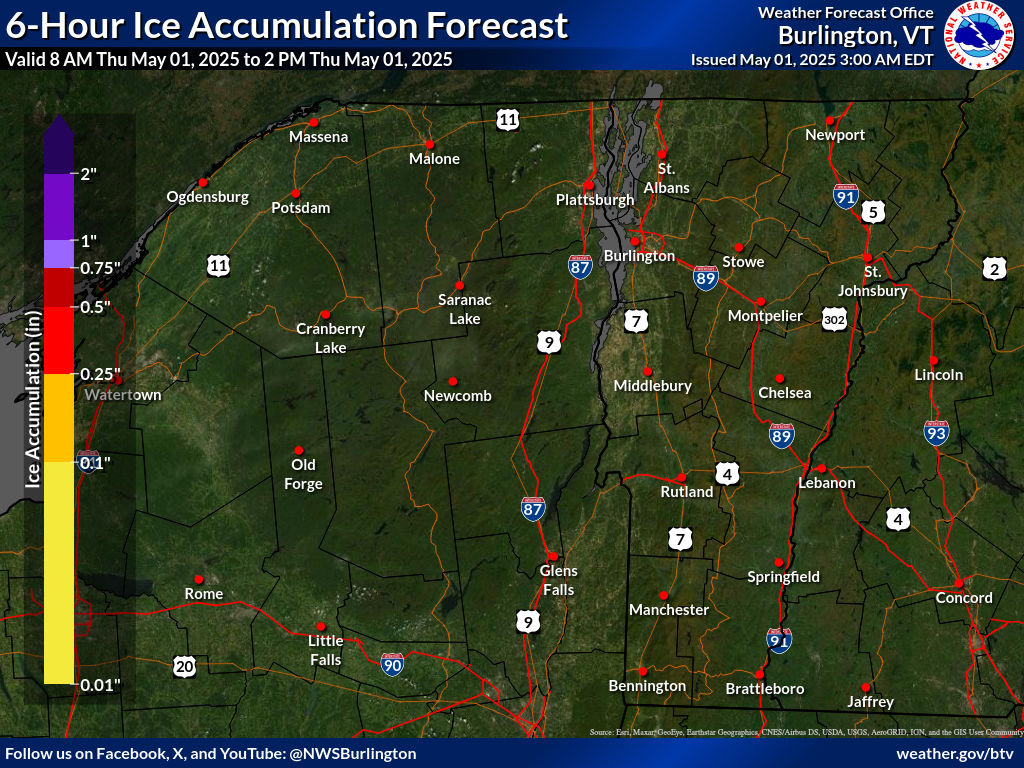
6-Hour Ice Accumulation Forecasts
These maps are official NWS ice accumulation forecasts in inches for
6-hour times periods as shown on the graphics. This ice accumulation is determined by
NWS forecasters to be the most likely outcome based on evaluation of data from computer
models, satellite, radar, and other observations.
Hover over thumbnails below to view larger image.


Precipitation Onset/End Timing
These maps represent the most likely time of winter precipitation
onset and ending (snow, sleet, freezing rain). Rain is not included here. This
information is provided when we issue a Warning or Advisory for expected snow or ice
accumulation; typically six to 24 hours in advance. Times are only given for places that
are under a Warning or Advisory. They will be blank in areas outside Warnings or
Advisories.
Onset of Wintry
Precipitation
End Timing of Wintry
Precipitation
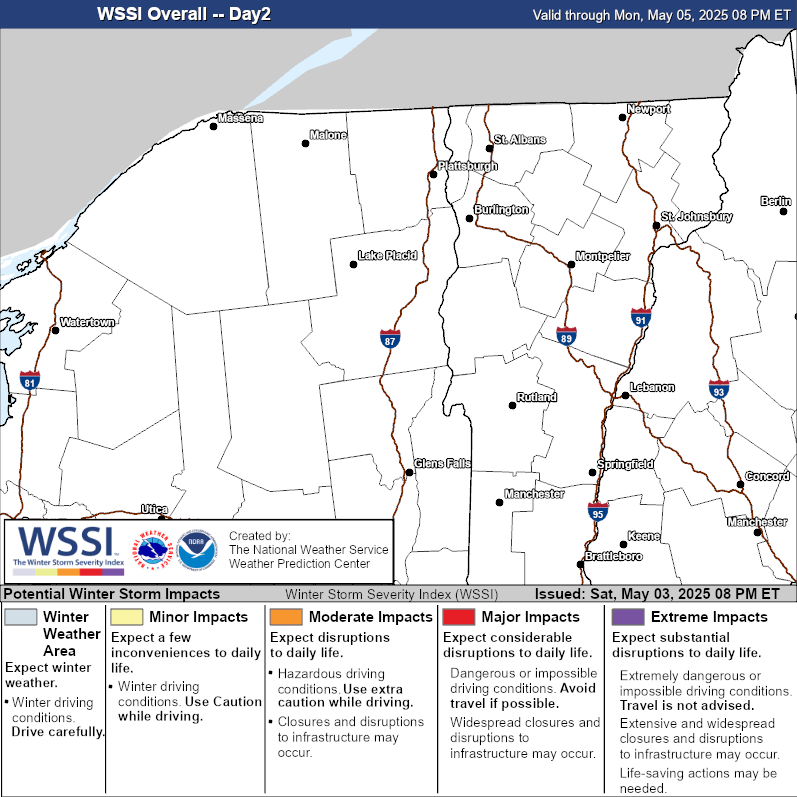
Winter Storm Severity Index
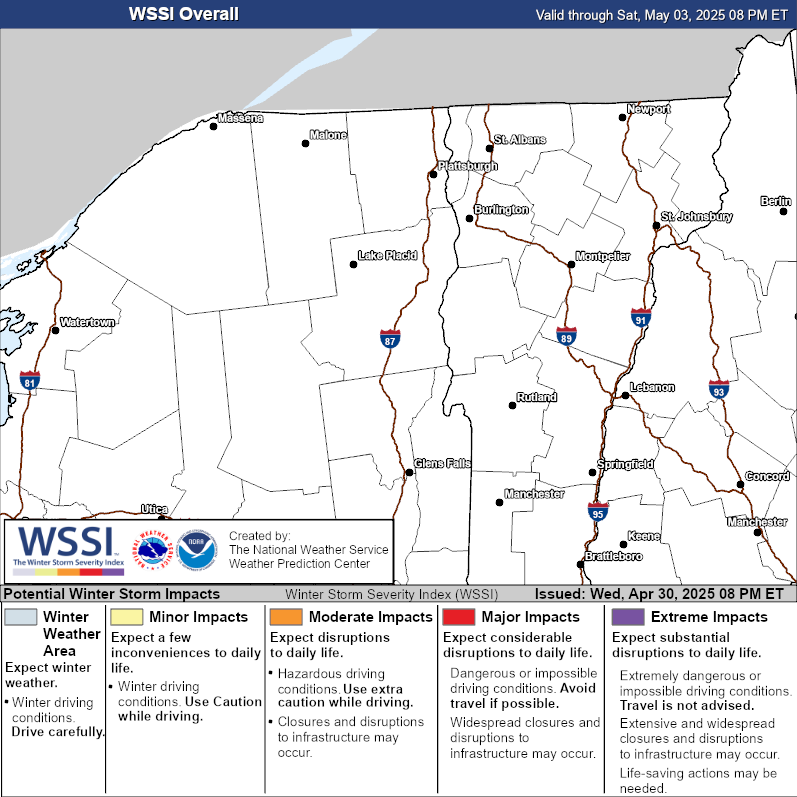
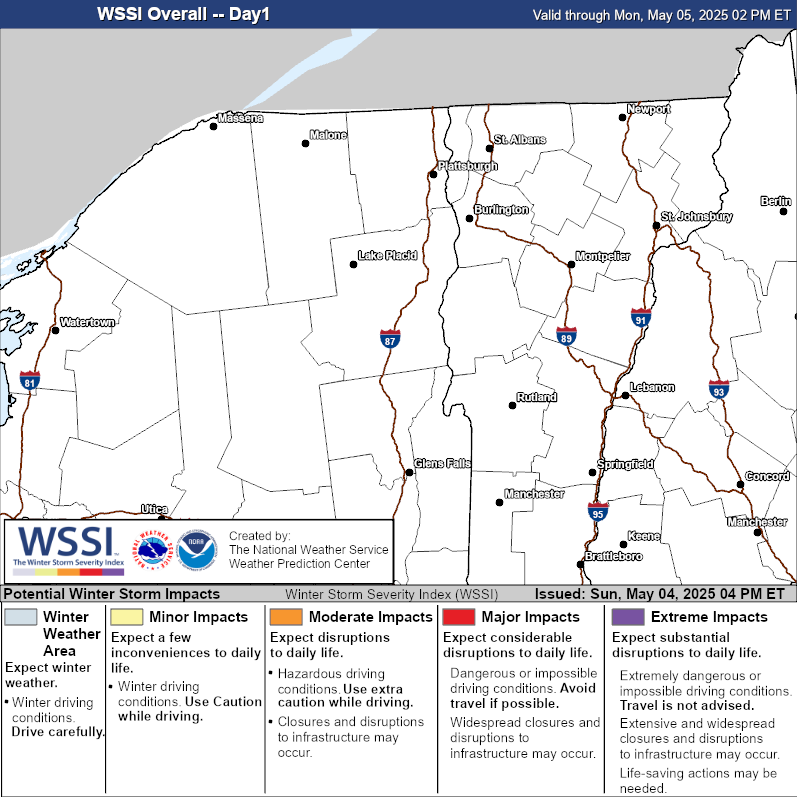
The WSSI is created through the use of Geographic Information Systems
(GIS) by screening the official National Weather Service (NWS) gridded forecasts from
the National Digital Forecast Database (NDFD) for winter weather elements and combining
those data with non-meteorological or static information datasets (e.g., climatology,
land-use, urban areas). This process creates a graphical depiction of anticipated
overall impacts to society due to winter weather. The underlying structure of the WSSI
allows it to potentially use other meteorological datasets as inputs (e.g.,
deterministic or ensemble model output) to create additional guidance products that
cover periods beyond those covered by the NDFD. The WSSI provides a classification of
the overall expected severity of winter weather using the following terminology:
“Minor,” “Moderate,” “Major,” and
“Extreme.” The “Winter Weather Area” pertains to areas where
winter weather conditions are expected, but are not anticipated to impact daily life.
Days 1-3
Day 1
Day 2
Day 3

Storm Prediction Center Convective Outlooks
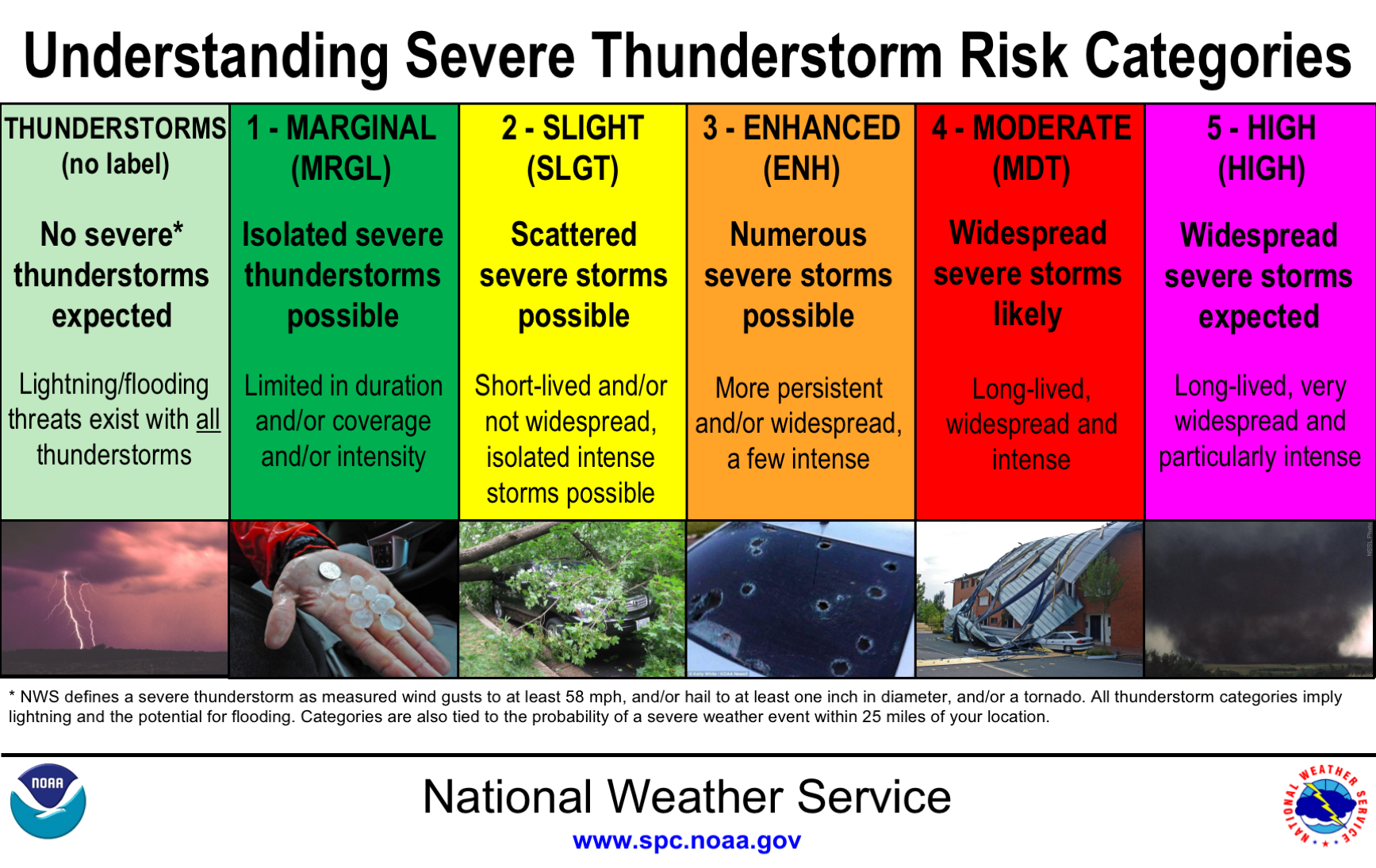
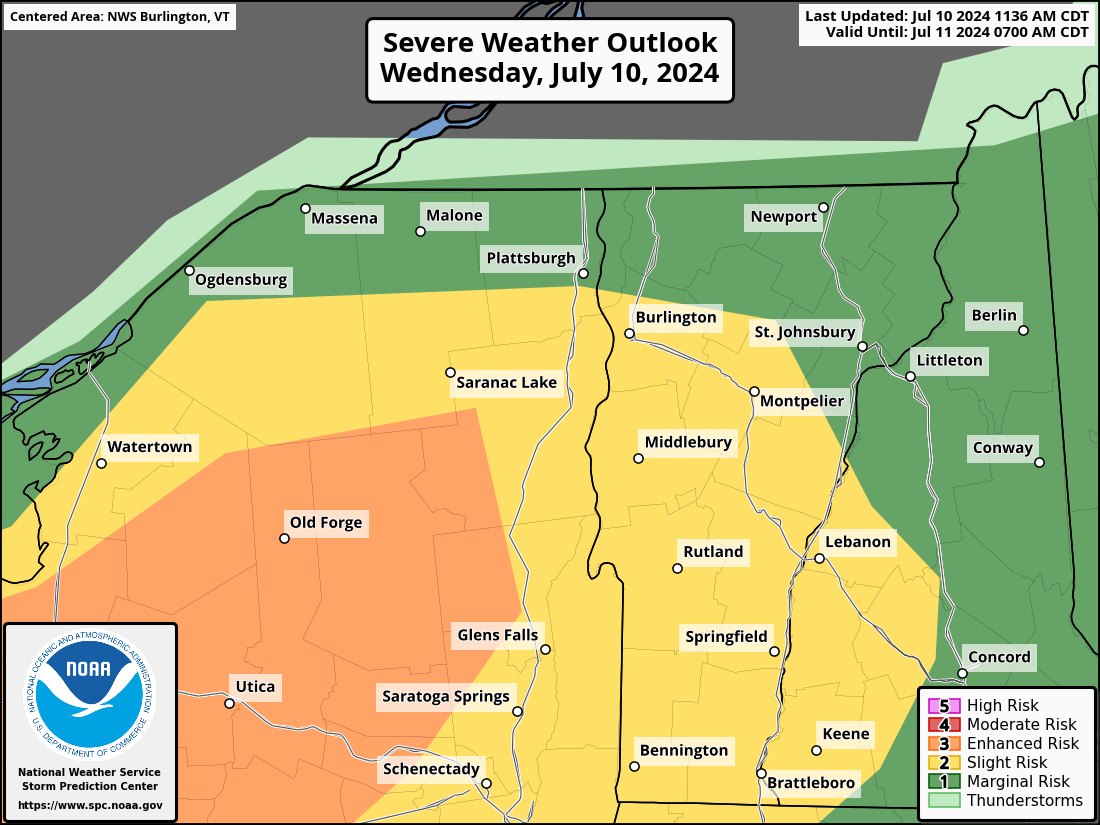
The Storm Prediction Center (SPC) issues Day 1, Day 2, and Day 3
Convective Outlooks that depict non-severe thunderstorm areas and severe thunderstorm
threats across the contiguous United States, along with a text narrative. The
categorical forecast specifies the level of the overall severe weather threat via
numbers (e.g., 5), descriptive labeling (e.g., HIGH), and colors (e.g., magenta). The
probabilistic forecast directly expresses the best estimate of a severe weather event
occurring within 25 miles of a point.
Day 1
Day 2
Day 3


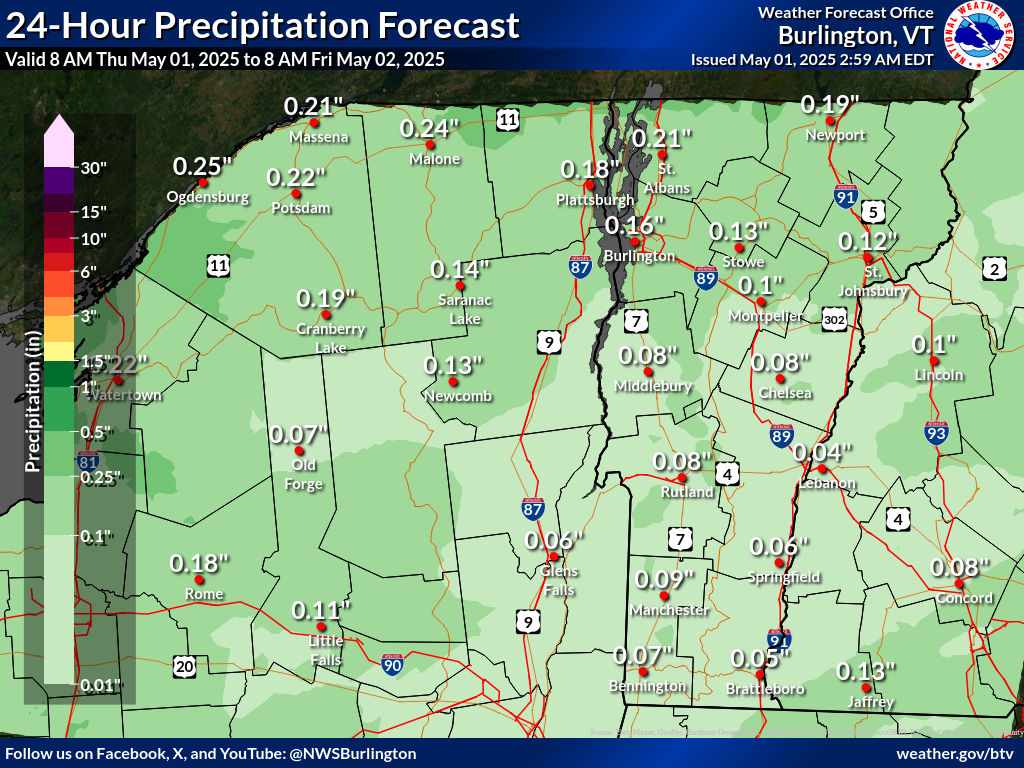
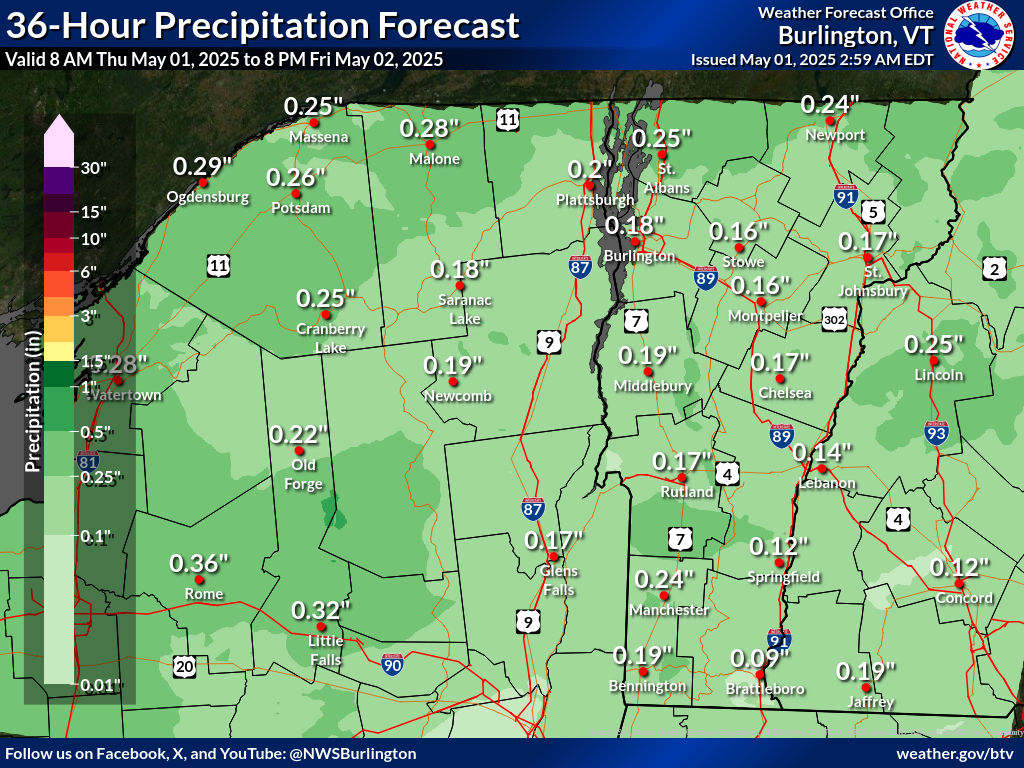
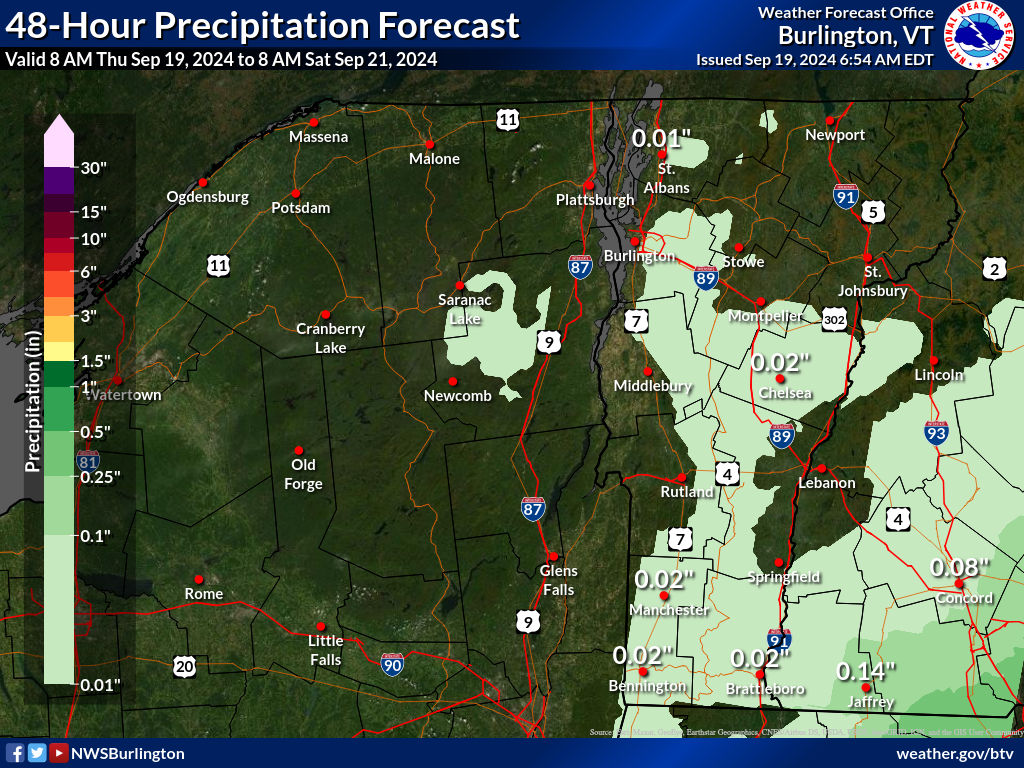
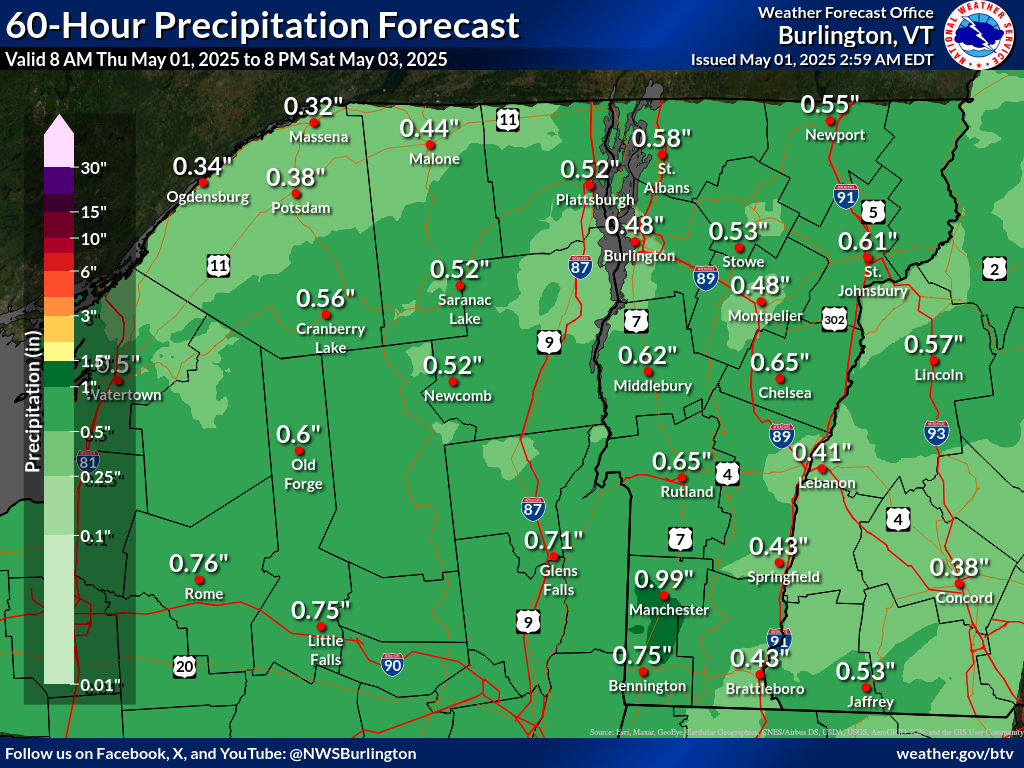
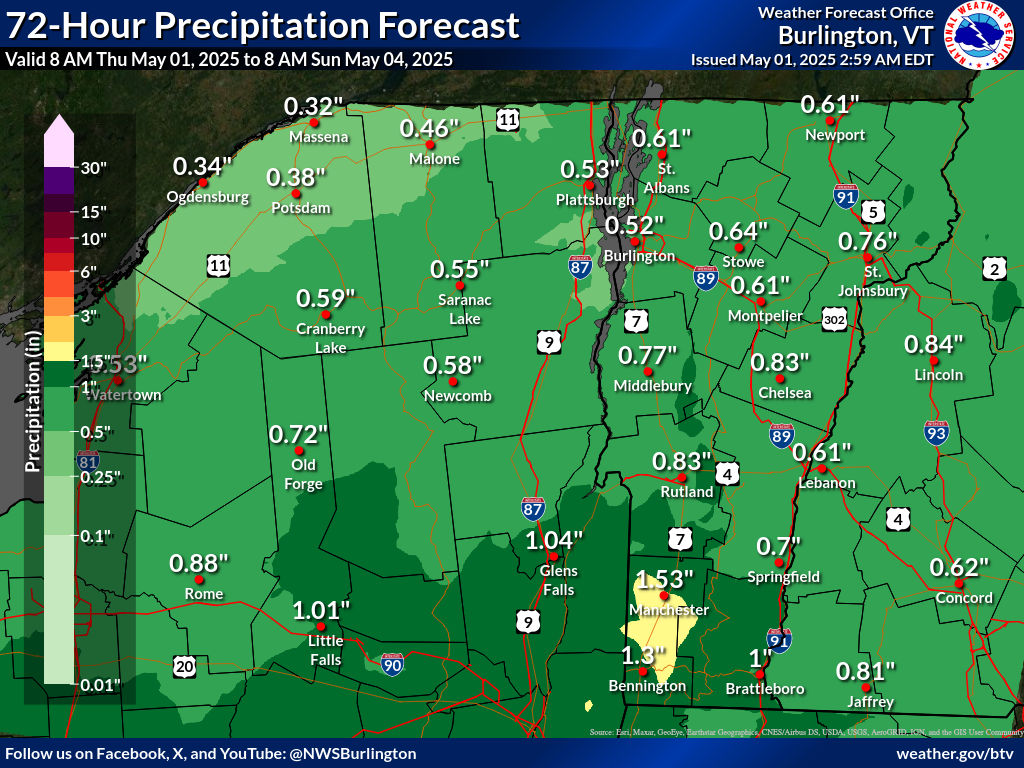
Liquid Precipitation Forecasts
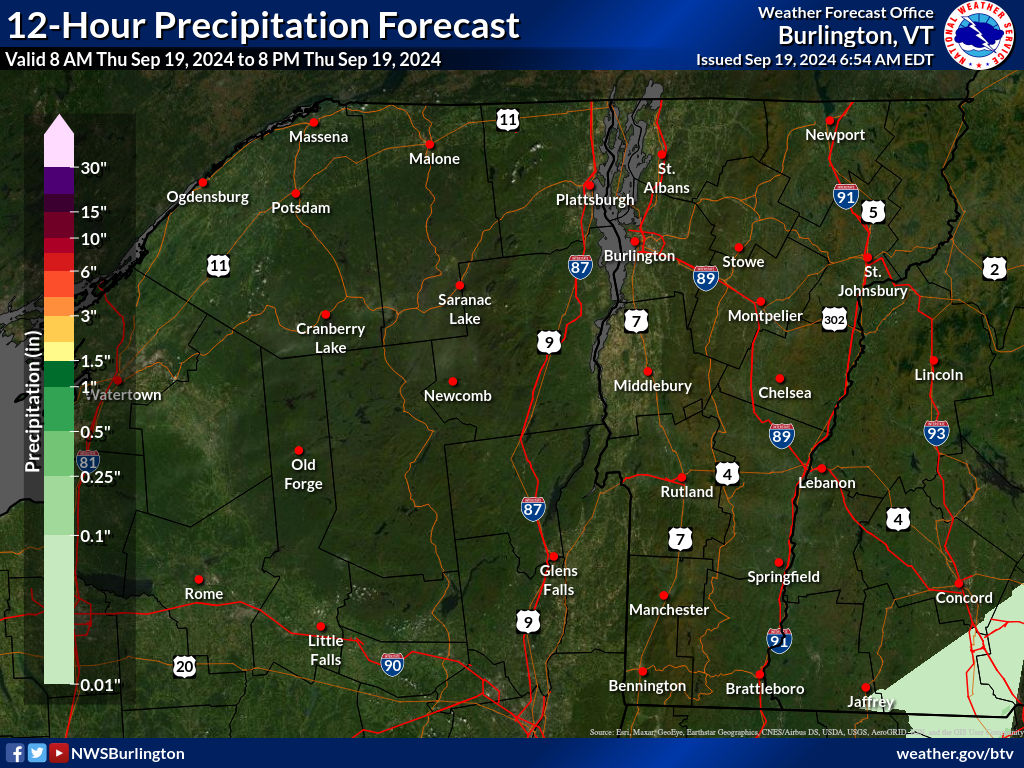
These maps are official NWS liquid precipitation forecasts in inches
for the time periods as shown on the graphics. This liquid precipitation is determined
by NWS forecasters to be the most likely outcome based on evaluation of data from
computer models, satellite, radar, and other observations.
Hover over thumbnails below to view larger image.
 Radar
Radar Current Weather
 Rivers & Lakes
 Satellite
 Forecast Maps
 Hour by Hour Forecast
 Tropical Weather
 Graphical Hazards
 Recreational Forecast
 Forecaster's Discussion
 Text Bulletins
 Submit Storm Report
 Aviation
 Fire Weather/Spot
 Heat Safety
 Weather Hazard Briefing
 Climate Plots
 Skywarn
 Follow us on X
 Follow us on Facebook
 Follow us on YouTube
 BTV RSS Feed