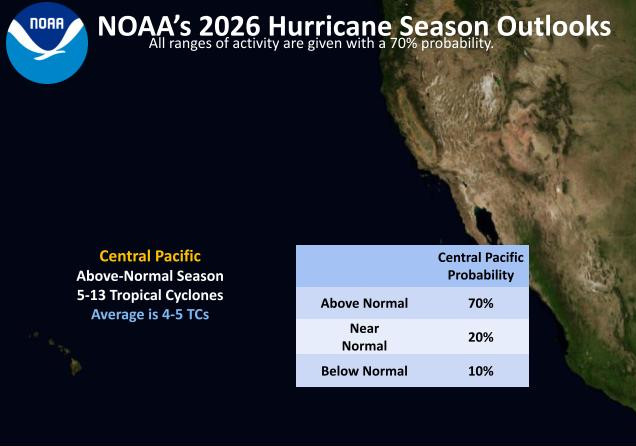
 Forecasters with NOAA’s National Weather Service are predicting an above-normal hurricane season for the central Pacific basin this year. NOAA’s outlook for the 2026 hurricane season, which runs June 1 to November 30, predicts a 70% chance of an above-normal season, a 20% chance of a near-normal season, and a 10% chance of a below-normal season.
The agency is forecasting a total of 5-13 tropical cyclones across the central Pacific, which is located north of the equator between 140°W and the International Date Line. A near-normal season has 4 or 5 tropical cyclones. Tropical cyclones include tropical depressions, tropical storms and hurricanes.
“With the most advanced forecast modeling and hurricane tracking technologies, NOAA and the National Weather Service are prepared to deliver real-time storm forecasts and warnings,” said Commerce Secretary Howard Lutnick. “Our experts are integrating cutting-edge tools to ensure communities in the path of storms receive the earliest, most accurate information possible.”
“NOAA’s rapid integration of advanced technology, including AI-based weather models, drones, and next-generation satellite data will deliver actionable science to safeguard the lives and livelihoods of the American people,” said NOAA Administrator Neil Jacobs, Ph.D. “These new capabilities, combined with the unmatched expertise of our National Weather Service forecasters, will produce the most accurate forecasts possible to protect communities in harm’s way.”
Key factor driving NOAA’s forecast
The most recent forecast from the NOAA Climate Prediction Center indicates El Niño conditions are expected throughout the hurricane season, with the tropical Pacific most likely to experience a moderate or stronger El Niño. Strong El Niño conditions are typically associated with dramatically elevated levels of activity in the central Pacific.
NOAA’s outlook is for overall seasonal activity based on large-scale weather and climate patterns. It does not indicate where or when any storms may affect land, as that is determined by short-term and variable weather patterns, and is not a landfall forecast.
“Preparing now for hurricane season — and not waiting for a storm to threaten — is essential for staying ahead of any storm. Visit weather.gov/safety and ready.gov for important preparedness information,” said NOAA’s National Weather Service Director Ken Graham.
An in-depth technical discussion of the central and eastern Pacific season outlook is available here:
https://www.cpc.ncep.noaa.gov/products/Epac_hurr/
New and enhanced communication products this season
Media contact
NOAA National Weather Service Public Affairs team at: nws.pa@noaa.gov



 Follow us on X
 Follow us on Facebook
 Follow us on YouTube
 HFO RSS Feed