
Heavy rain and widely scattered severe storms are expected over portions of the central and southern Plains into the Ohio Valley. Unseasonable warmth will continue for a few more days across the Midwest, Southeast, and Mid-Atlantic where several daily record highs could fall. Read More >
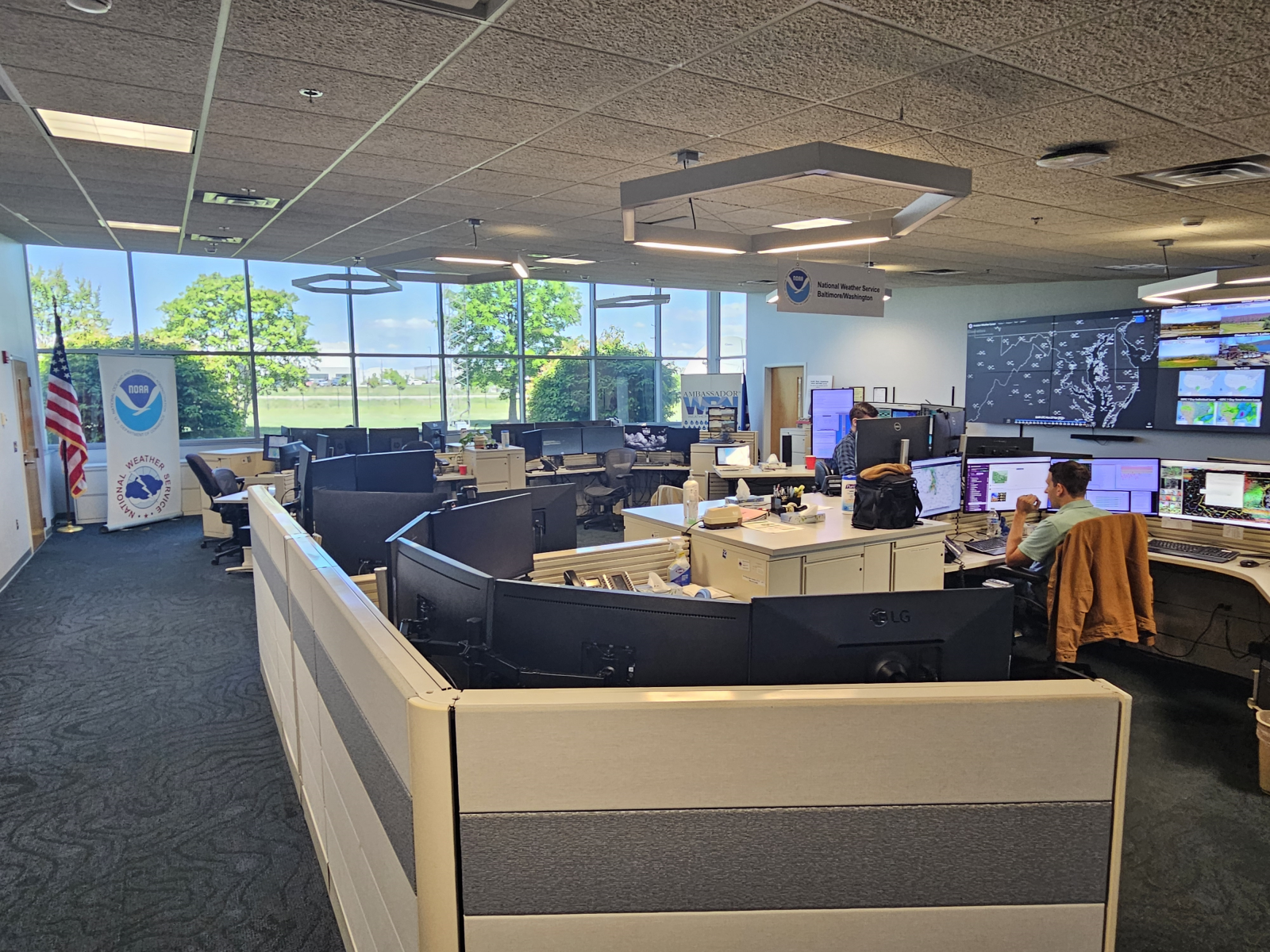
FORECAST OPERATIONS Forecasters at each local NWS forecast office perform several different tasks on a day-to-day basis, which serve a variety of customers. A gridded forecast database that is accessible on our website is continually updated. This database provides forecasts for several different weather elements (ex: temperature, dewpoint, relative humidity, wind, wind gust, probability of precipitation, weather type, etc.) out through 7 days over both land and water. Terminal Aerodrome Forecasts (TAFs) are issued for airports. Locally, we issue TAFs for Reagan National Airport (DCA), Baltimore-Washington International Thurgood Marshall Airport (BWI), Washington Dulles International Airport (IAD), Martin State Airport (MTN), Charlottesville Airport (CHO), and Eastern West Virginia Regional Airport (MRB) every six hours, with scheduled amendments required every three hours for DCA, BWI, and IAD, and additional updates as needed. Marine forecasts, fire weather forecasts, and coastal flood forecasts are also issued throughout the day. Another core responsibility of a forecaster is providing impact-based decision support services (IDSS) to partners. IDSS can be both routine or scheduled, and either remote or on-site. IDSS typically occurs in the form of briefings (spoken or via a formal presentation) or spot forecasts. As an example, we routinely prepare a briefing on upcoming hazardous weather over the next week for area emergency managers each Monday, Wednesday, and Friday. Sometimes forecasters are also deployed on-site for large events to provide weather support directly to emergency managers. Forecasters also regularly take weather observations, issue daily climate reports for several area locations, quality control multiple types of data, post on social media, answer phone calls, and launch weather balloons twice a day. All of the tasks above require forecasters to interrogate many different types of weather data such as radar, satellite, surface observations, upper air observations, and forecast model data to both develop and message the day's forecast to both the general public and our partners.
Before forecasters decide what the forecast will be, they need to review the latest weather information. That process will be described on the next page.
|



 Radar
Radar Current Weather
 Rivers & Lakes
 Satellite
 Forecast Maps
 Hour by Hour Forecast
 Tropical Weather
 Graphical Hazards
 Marine Forecasts
 Forecaster's Discussion
 Text Bulletins
 Fire Weather
 Weather Hazard Briefing
 Climate Plots
 Coastal Flood
 Skywarn
 Submit Storm Report
 FAQ
FAQ Follow us on X
 Follow us on Facebook
 Follow us on YouTube
 LWX RSS Feed