
Pacific tropical moisture wrapping into a storm will continue a multi-day heavy rainfall event this week that will impact the Southwest into the Plains. Scattered severe thunderstorms capable of mainly severe wind gusts appear possible across portions of the southern Plains this afternoon into tonight. There is also a risk of isolated severe winds gusts and tornadoes in Kansas into Nebraska. Read More >
 |
|||||||||||
|
|||||||||||
| Watches, Warnings, & Reception | |||||||||||
| Watches & Warnings | |||||||||||
|
A WATCH means that conditions are favorable for hazardous weather to develop. For example, a Severe Thunderstorm Watch means that conditions |
|||||||||||
| Wireless Emergency Alerts | |||||||||||
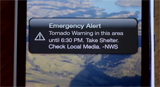
| Wireless Emergency Alerts (WEA) are emergency messages sent by authorized government alerting authorities through your mobile carrier. Government partners include local and state public safety agencies, FEMA, the FCC, the Department of Homeland Security, and the National Weather Service. No signup is required! Alerts are sent automatically to WEA-capable phones during an emergency. | |||||||||||
|
Alerts received at the right time can help keep you safe during an emergency. With WEA, alerts can be sent to your mobile device when you may be in harm's way, without the need to download an app or subscribe to a service.
What types of WEA messages will the National Weather Service send?
WEA messages include a special tone and vibration and both will be repeated twice.
|
|
||||||||||
|
When you receive a WEA, following any action advised by the emergency message. Seek more details from your favorite TV or radio station, NOAA Weather Radio, news website, desktop or mobile app, or other trust source of information. |
||||||||||
| NOAA Weather Radio | |||||||||||
| Known as the "Voice of NOAA's National Weather Service," NOAA All Hazards Weather Radio (NWR) is a nationwide network of more than 1000 transmitters, covering all 50 states, adjacent coastal waters, Puerto Rico, the U.S. Virgin Island, and the U.S. Pacific Territories. These stations broadcast continuous weather information directly from the nearest National Weather Service office. NWR broadcasts official Weather Service warnings, watches, forecasts, and other hazard information 24 hours a day, 7 days a week. Click here to learn more about NOAA Weather Radio. Click here to look at coverage maps to find the best NWR frequency for your location. |
|||||||||||
| Back to Top | |||||||||||




 Follow us on X
 Follow us on Facebook
 Follow us on YouTube
 SHV RSS Feed