North Myrtle Beach, South Carolina Spring and Fall Freeze Statistics
|
North Myrtle Beach's average date for the last spring freeze is March 14
Spring freeze statistics sorted by probability
| Probability |
Date |
| 1% |
Feb 7 |
| 5% |
Feb 17 |
| 10% |
Feb 22 |
| 25% |
Mar 4 |
| 50% |
Mar 14 |
| 75% |
Mar 24 |
| 90% |
Apr 3 |
| 95% |
Apr 8 |
| 99% |
Apr 18 |
Earliest last spring freeze: Feb 8, 2024
Latest last spring freeze: April 22, 1943
|
Spring freeze statistics sorted by date
| Date |
Probability |
| Jan 25 |
0.1% |
| Feb 1 |
0.3% |
| Feb 5 |
0.7% |
| Feb 10 |
1.6% |
| Feb 15 |
3.6% |
| Feb 20 |
7.0% |
| Feb 25 |
12.5% |
| Mar 1 |
18.8% |
| Mar 5 |
26.7% |
| Mar 10 |
38.4% |
| Mar 15 |
51.3% |
| Mar 20 |
64.1% |
| Mar 25 |
75.5% |
| Mar 30 |
84.5% |
| Apr 5 |
92.1% |
| Apr 10 |
95.9% |
| Apr 15 |
98.1% |
| Apr 20 |
99.2% |
| Apr 25 |
99.7% |
| Apr 30 |
99.9% |
| May 5 |
100.0% |
| May 10 |
100.0% |
|
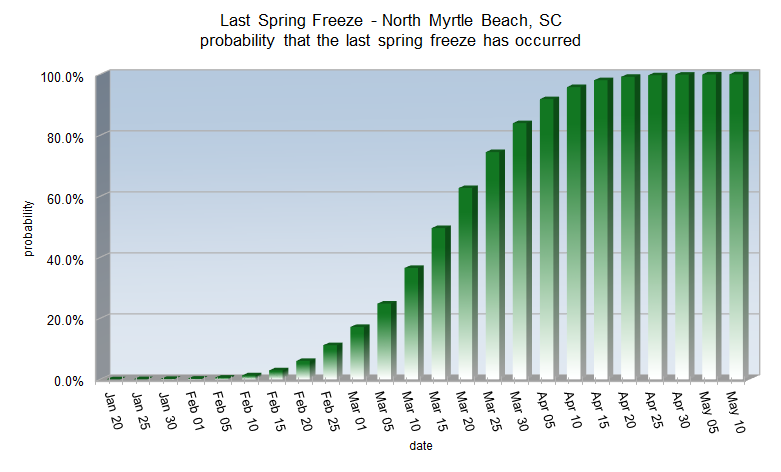
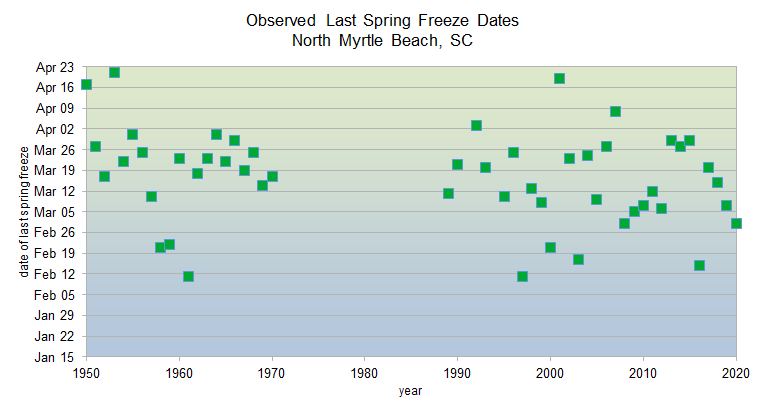
Since 1955, North Myrtle Beach has 20 years of missing climate data. This makes it difficult to determine a statistically accurate change in spring freeze dates.
|
|
North Myrtle Beach's average date for the first fall freeze is November 17
Fall freeze statistics sorted by probability
| Probability |
Date |
| 1% |
Oct 20 |
| 5% |
Oct 28 |
| 10% |
Nov 1 |
| 25% |
Nov 9 |
| 50% |
Nov 17 |
| 75% |
Nov 25 |
| 90% |
Dec 2 |
| 95% |
Dec 6 |
| 99% |
Dec 14 |
Earliest first fall freeze: October 26, 1962
Latest first fall freeze: December 22, 1948
|
Fall freeze statistics sorted by date
| Date |
Probability |
| Oct 1 |
0.0% |
| Oct 5 |
0.0% |
| Oct 10 |
0.1% |
| Oct 15 |
0.3% |
| Oct 20 |
0.9% |
| Oct 25 |
2.5% |
| Nov 1 |
8.7% |
| Nov 5 |
15.3% |
| Nov 10 |
24.7% |
| Nov 15 |
43.0% |
| Nov 20 |
59.7% |
| Nov 25 |
74.8% |
| Nov 30 |
86.2% |
| Dec 5 |
93.5% |
| Dec 10 |
97.4% |
| Dec 15 |
99.1% |
| Dec 20 |
99.7% |
| Dec 25 |
99.9% |
| Dec 30 |
100.0% |
|
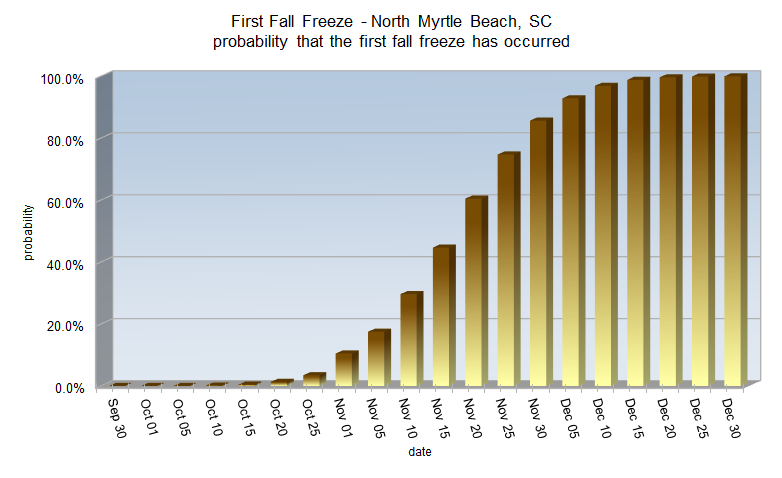
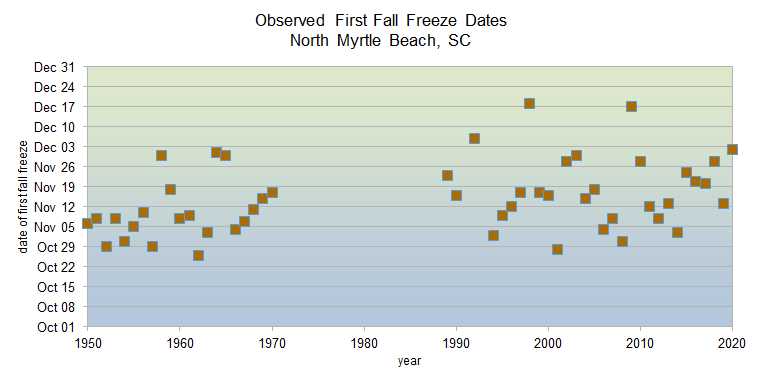
Since 1955, North Myrtle Beach has 20 years of missing climate data. This makes it difficult to determine a statistically accurate change in fall freeze dates.
|
|
North Myrtle Beach's average growing season length is 246 days
Growing season statistics sorted by probability
| Probability |
Days |
| 1% |
300 |
| 5% |
284 |
| 10% |
276 |
| 25% |
262 |
| 50% |
246 |
| 75% |
230 |
| 90% |
216 |
| 95% |
207 |
| 99% |
191 |
Shortest growing season: 191 days in 2001
Longest growing season: 295 days in 2024
|
Growing season statistics sorted by days
| Days |
Probability |
| 160 |
100.0% |
| 170 |
99.9% |
| 180 |
99.8% |
| 190 |
99.2% |
| 200 |
97.5% |
| 210 |
93.7% |
| 220 |
86.6% |
| 225 |
81.4% |
| 230 |
75.2% |
| 235 |
68.0% |
| 240 |
60.0% |
| 245 |
51.6% |
| 250 |
43.1% |
| 255 |
34.9% |
| 260 |
27.4% |
| 270 |
15.2% |
| 280 |
7.3% |
| 290 |
3.0% |
| 300 |
1.0% |
|
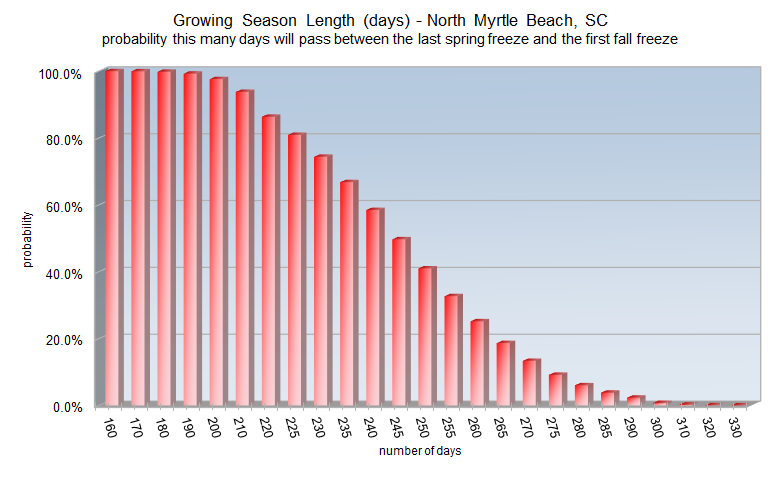
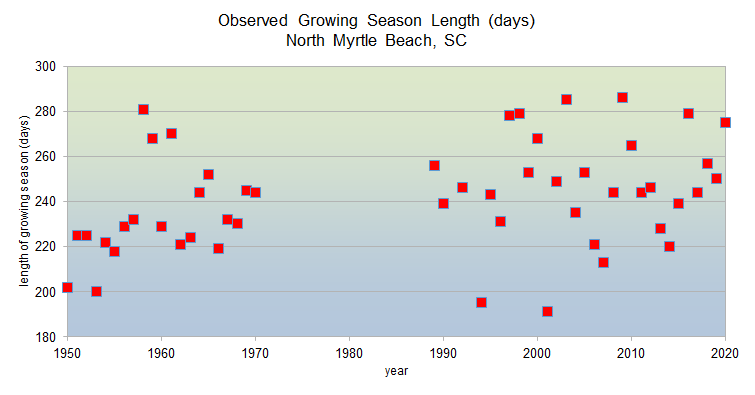
Since 1955, North Myrtle Beach has 20 years of missing climate data. This makes it difficult to determine a statistically accurate change in growing season length.
|
Research and Page Author: Tim Armstrong & Vicky Oliva
Last Updated: September 17, 2026



 Radar
Radar Current Weather
 Rivers & Lakes
 Satellite
 Forecast Maps
 Hour by Hour Forecast
 Tropical Weather
 Graphical Hazards
 Weather Hazard Briefing
 Forecaster's Discussion
 Text Bulletins
 Climate
 Skywarn
 NOAA Weather Radio
 Sunrise/Sunset
 Marine Forecasts
 Beach & Surf
 Coastal Flood
  Follow us on X
 Follow us on Facebook
 Follow us on YouTube
 ILM RSS Feed