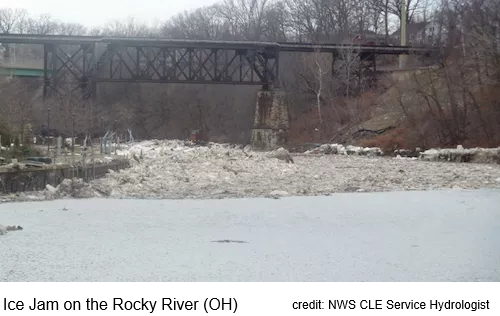
What: Ice jams are chunks of ice which pile up together. Ice jams then become a mini dam, holding back water that should flow freely.
When: Ice jams most commonly form when temperatures warm up after a long cold spell, especially when an influx of rain into the waterway also causes ice to break up and move around.
Where: The more-common locations where ice jams occur are:
Ice jams can lead to danger in two ways:
1) The water that backs up behind the ice jam can flood areas behind/upstream of the jam.
2) If the jam breaks up suddenly, the outpouring and force of all that pent up water may wash away things below/downstream of the old jam much like a dam break would, but on a much smaller scale.
Our partnerships: The NWS works with our partners who have river/flooding interests to spot ice jams and get the word out (including issuing flood statements, and flood warnings or flash flood warnings for the most dangerous jams) to people about any possible dangers associated with any large jams or jams which will affect infrastructure, transportation, residences, or businesses.
Some of our partnerships include: Several river ice observers whom we train to report ice formation, break up and jams on the larger rivers. See the reports they send to us in these special river statements; The PA Emergency Management Agency (PEMA) and county and local emergency management agencies; trained weather spotters; and the Susquehanna River Basin Commission (SRBC).



 Radar
Radar Current Weather
 Rivers & Lakes
 Satellite
 Forecast Maps
 Hour by Hour Forecast
 Tropical Weather
 Graphical Hazards
 Weather Hazards Briefing
 Fire Weather
 Text Forecasts and Statements
 Forecaster's Discussion
 Send Us a Report
 KCCX Local Radar (Hi-Res)
 Drought
 Winter
 Follow us on X
 Follow us on Facebook
 CTP RSS Feed